AI is Replacing Jobs. How Can You Lead Your Employees Through the Transition?
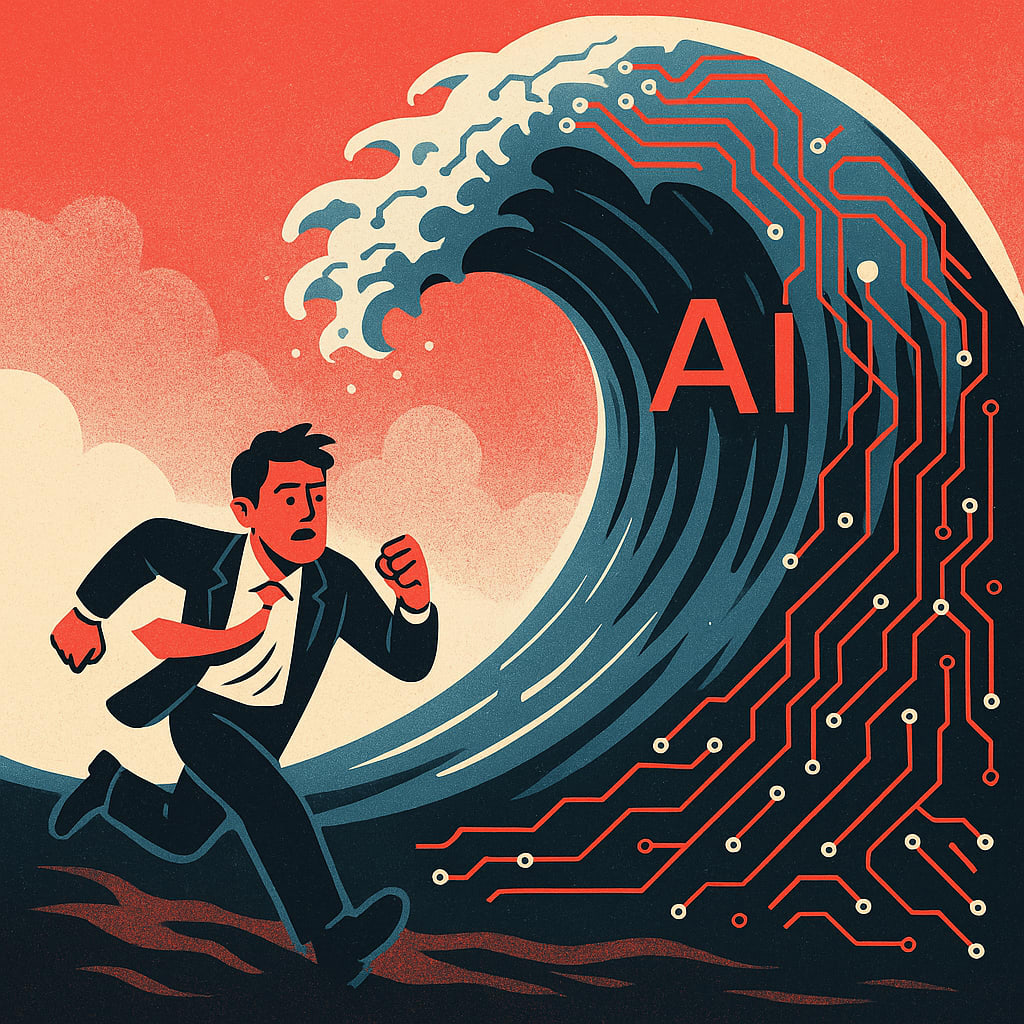
🌪️ SUPER BAD: The AI Wave Is Already Crashing In
AI isn’t coming. It’s here.
41% of employers globally plan to reduce their workforce because of AI in the next 5 years.
14% of workers have already been displaced by AI.
The first jobs going? Translators, historians, sales reps, customer service, writers, and data scientists.
But here’s the kicker: most leaders are still treating AI as a tech upgrade. It’s not. It’s a human earthquake.
If you’re in healthcare, education, retail, finance, or government, you’re not just updating your tools. You’re reshaping lives, careers, and identities.
And if you don’t talk about it honestly? Your people will find out the hard way.
🔎 What No One Tells You (That You Desperately Need to Know)
Let’s be blunt: the AI transition is already creating a trust crisis.
80% of U.S. workers are using AI on the job.
45% are doing it without telling their boss.
69% aren’t honest about how much help they’re getting.
38% exaggerate their AI skills just to stay competitive.
And two-thirds are paying for their own AI tools to keep up.
Why the secrecy? Because honesty gets punished. Harvard found that workers who disclose AI usage are seen as less competent—especially if they’re women or older. In other words, people are hiding the very thing that could help them thrive.
And while companies spin “reorgs” and “optimizations,” the truth is that AI is already cutting jobs. Klarna openly dropped from 5,000 to 3,000 employees. IBM swapped 200 HR folks for a chatbot. Most companies just don’t say the quiet part out loud.
Thanks for reading Crazy Good: Thinking better. Feeling deeper. Living smarter.! This post is public so feel free to share it.
Share
✨ CRAZY GOOD: Lead the AI Transition with Head, Heart, and Gut
You don’t need to be perfect. But you do need to be honest, human, and strategic. Here’s how:
🧠 HEAD: Build a Smart, Clear Plan
1. Tell the Truth Early
Don’t wait until people are panicking. Say:
“AI is already changing our industry. Our choice is to lead or get left behind.”
“We will be transparent about AI’s impact on every role.”
“No AI decisions will be made without employee input and transition planning.”
2. Be Specific By Role
Generic promises won’t cut it. Use Microsoft’s AI Applicability Matrix:
High Risk of Immediate Change:
Customer service
Sales
Content writing
Data analysis
Medium-Term Impact (2-5 years):
Project managers
PR & marketing
Junior legal roles
Low Impact (5+ years):
Skilled trades
First responders
Therapists
Give people clarity. Not spin.
3. Focus on Augmentation, Not Just Replacement
78% of companies using AI are aiming to augment roles. Lead with that.
Say:
“Here’s how AI can help you do your job better.”
“Here are tasks that might change—and what new opportunities that creates.”
Real Talk Example:
Massachusetts General Hospital uses AI to assist radiologists. As Dr. Richard Patel put it: “AI helps me spot what I might miss when tired. But it can’t explain a diagnosis to a patient or choose the best treatment.” That’s the sweet spot: AI assists, humans decide.
Crazy Good: Thinking better. Feeling deeper. Living smarter. is a reader-supported publication. To receive new posts and support my work, consider becoming a free or paid subscriber.
♥️ HEART: Make It Human
1. Acknowledge Fear Without Feeding Panic
Most workers are worried:
71% are anxious about AI.
65% worry it could replace their job.
Instead of denial, offer compassion:
“I know this is scary. Change is hard. We’re here to help you through it.”
Then back it up with a plan:
“We’re investing in retraining, and we’ll support you through every stage of transition.”
2. Don’t Punish Transparency
Remember: people hide AI use because they fear judgment. Fix that:
Avoid “AI used” tags in performance reviews.
Use blind evaluations based on results, not tools.
Model healthy AI usage from the top down.
And train managers to reward experimentation, not punish it.
3. Watch for Bias Hotspots
Non-users judge AI users harshly. Women and older workers get hit hardest. Fix that by:
Mapping your bias-prone teams
Getting skeptics to become allies
Building AI literacy across generations
4. Make Inclusion a Design Principle
Cross-train across roles and ages. Pair Gen Z with Boomers. Get nurses in the room with data scientists. AI works best when humans build it together.
🧭 GUT: Lead with Integrity and Boldness
1. Back Words with Action
Don’t say you’re “people first” and then cut everyone after rollout. Learn from IKEA:
Their chatbot “Billie” took 47% of customer service volume.
Instead of layoffs, they retrained 8,500 people into higher-value design and advisory roles.
That reskilling unlocked $1.4 billion in new revenue.
IKEA didn’t just save jobs. They grew the business because they bet on their people.
2. Admit When AI Makes Mistakes
AI isn’t magic. It breaks. It misunderstands. If you want trust:
Share what failed.
Explain how you’re fixing it.
Invite feedback early and often.
3. Use the “Honest Answer Framework”
Q: Will AI take my job?
“Some tasks may be automated. But here’s how we’re helping your role evolve.”
Q: Why should I train my AI replacement?
“You’re not training a replacement—you’re becoming irreplaceable by learning to use AI better than anyone else.”
Q: How do I know you won’t fire me once I help?
“Here are our retraining budgets, support paths, and our history of keeping promises.”
4. Celebrate Wins That Blend Human + AI
Look for stories like:
A teacher who used AI to personalize lessons and helped a struggling student finally succeed
A nurse who cut charting time by 50% and made it to her kid’s gymnastics meet
A financial analyst who used AI to find insights that helped a client avoid a costly mistake
Shine a light on these. Often. Publicly.
🌟 THE PHASED PLAYBOOK (And How to Nail Each Step)
Phase 1: Foundation (Months 1–3)
Focus: Build understanding, reduce fear
Town halls with Q&A
Anonymous feedback tools
Department-specific AI impact briefings
Phase 2: Skill Building (Months 4–9)
Focus: Train, identify champions
Personalized AI learning paths
Peer mentorships
Internal AI success showcases
Phase 3: Implementation (Months 10–18)
Focus: Transition roles, support people
Weekly AI progress updates
Individual coaching and planning
Cross-functional pilot teams
Phase 4: Optimization (Months 19+)
Focus: Scale success, stay adaptable
New roles and promotion paths
Innovation fellowships
Strategy refresh based on employee feedback
🎯 How to Know It’s Working (Hint: Not Just Productivity)
Leading Indicators:
Voluntary AI usage rates
Confidence scores in AI tools
Peer-to-peer AI coaching
Lagging Indicators:
Role evolution without attrition
Employee satisfaction scores
AI-augmented output quality
Trust Signals:
More questions are tactical, not fearful
More people offer to help with AI rollout
More laughter during change meetings (!)
🚀 The Life Upgrade: AI as a Door, Not a Doom
This isn’t just about business strategy. It’s about human potential.
AI is a chance to:
Give people time back for creativity, family, and purpose
Replace micromanagement with trust and mastery
Build workplaces where humans aren’t burned out, but brilliant
This isn’t the death of work. It’s the birth of better work—if we lead it that way.
So here’s your Crazy Good challenge:
Lead with transparency, even when it’s messy.
Build safety so people can grow.
Elevate humanity while embracing technology.
Because the future isn’t man vs. machine. It’s humans who get it vs. those who don’t.
And if you’re reading this?
You’re one of the ones who gets it.
Let’s go.
Share
Subscribe now
SOURCES:
McKinsey & Co. “AI in the Workplace: 2025 Report”
Microsoft WorkLab Research
Harvard Business Review
Orgvue AI Workforce Survey (2025)
EY Press Release (AI Ethics & Anxiety Study)
Josh Bersin: The Rise of the Superworker
IKEA AI case study, SevenFour Digital
RAND Corporation (AI in healthcare)
Spencer Education (AI in teaching)
HR Dive, HR Morning, Fortune BrandStudio