Dogs, AI, and Eating Stuff You Shouldn't
You know the terrifying stats, probably…
41% of employers are planning workforce reductions due to AI in the next five years.
30% of US jobs could be automated by 2030
These aren’t assembly line jobs. They’re white collar jobs.
Your job. My job.
The people who are most at likely to be replaced by robots are those who **live and work **like ROBOTS.
Behind the Keynote: Joy, Productivity, and Profit is a reader-supported publication. To receive new posts and support my work, consider becoming a free or paid subscriber.
Running on autopilot. Limiting exposure to anything uncomfortable.
Following scripts.
Avoiding the messy work of actually examining what they believe and why.
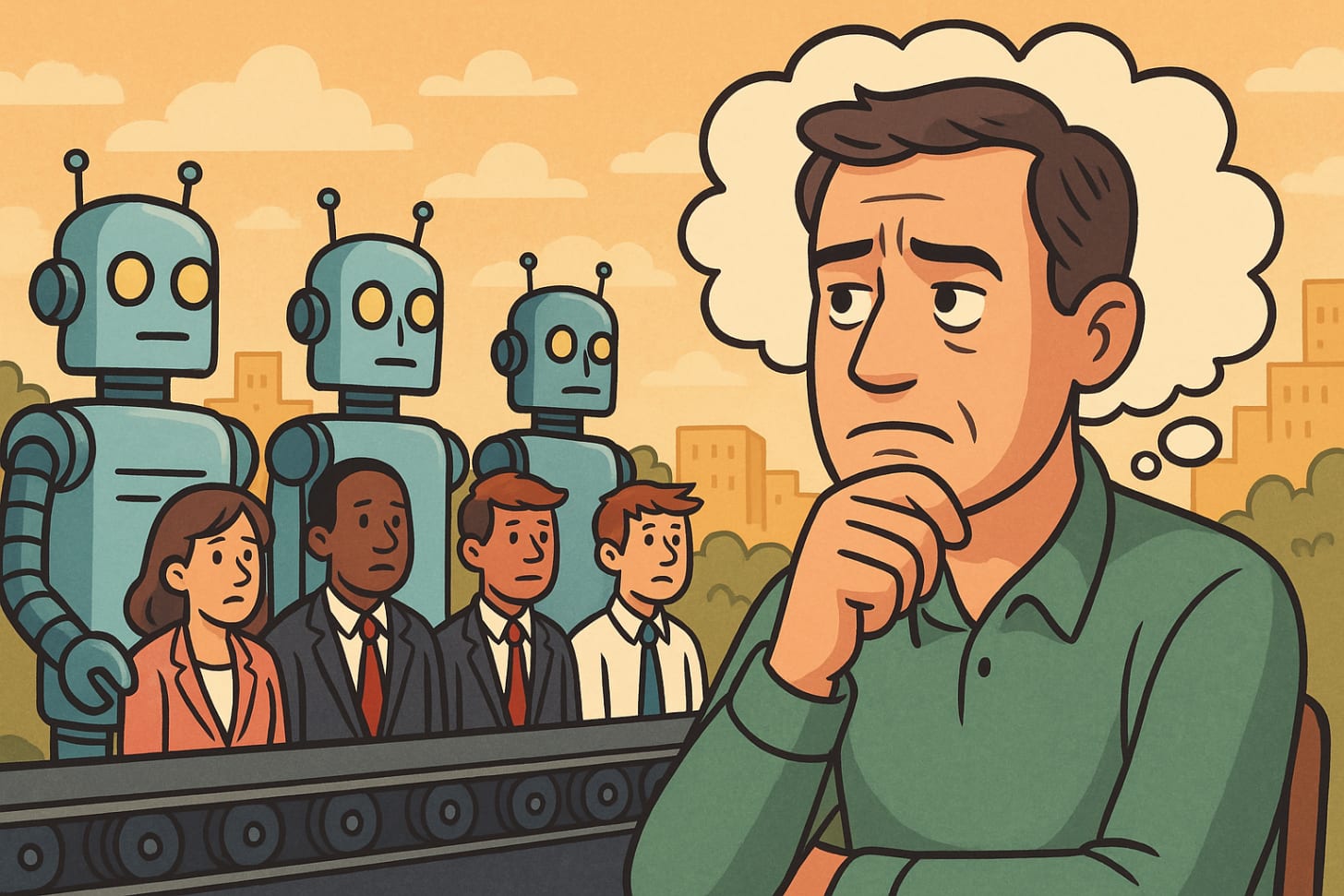
Your competitive advantage in an AI world isn’t becoming more efficient or more optimized. AI does that better than we ever will. The winning move is to become more human.
And that starts with noticing all the ways we’ve already become machines.
The signature of robotic thinking is premature certainty.
You hear it from politicians who know exactly how the world works.
From CEOs who know exactly where the market is going.
From tech prophets who know exactly what AI will and won’t do.
Sometimes the more confident people sound, the less they actually know.
I once had a cult leader who was certain I’d die if I visited my sick grandmother, and a doctor certain my wife shouldn’t drink coffee after surgery.
Both were wrong—and in both cases, ignoring their certainty was the right call on my part.
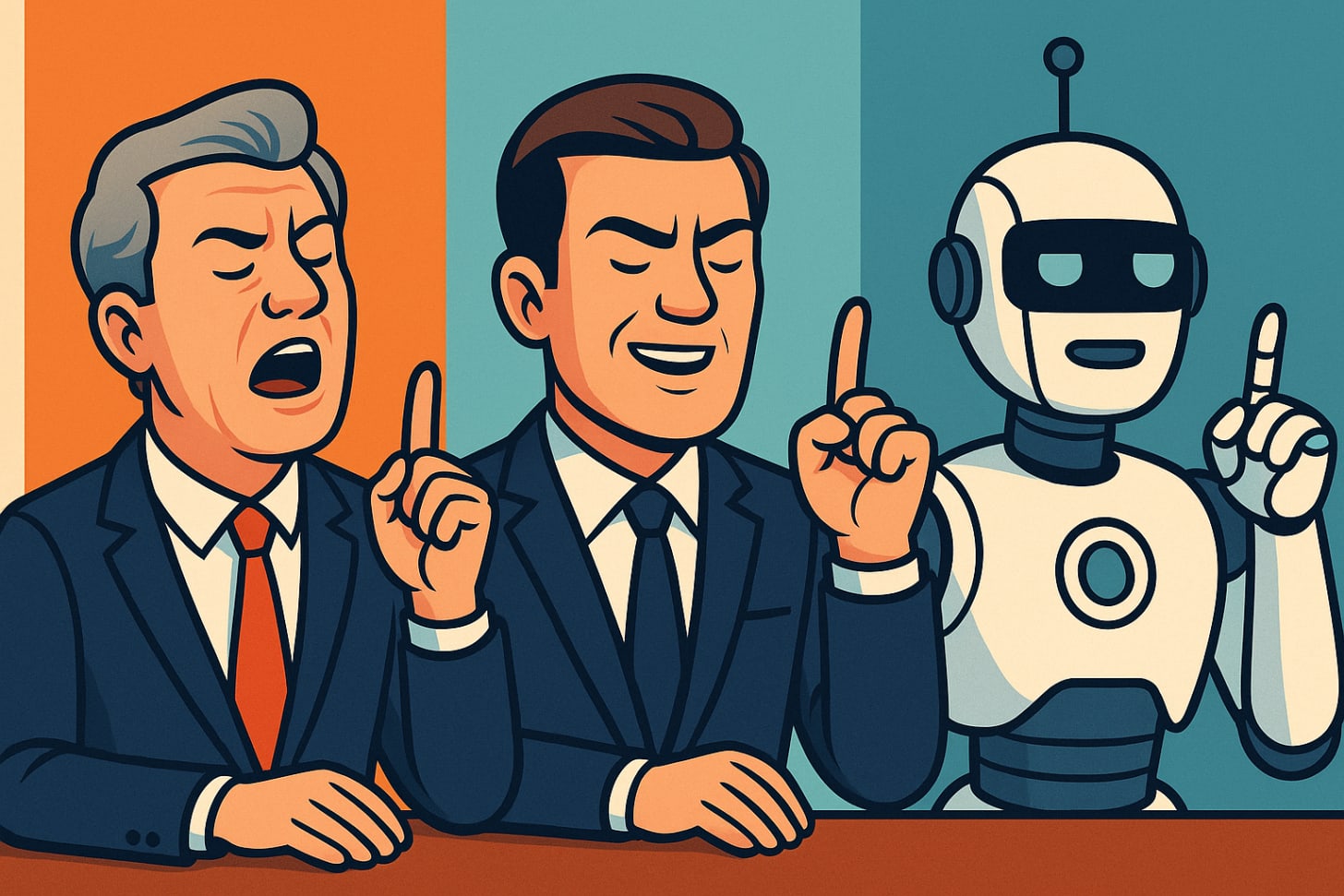
Beware of “premature certainty” - it’s usually B.S. or ignorance.
The robot move is always closing the question before it’s actually resolved. The human move is staying in the question. Sitting with “maybe” when everyone around you is demanding you pick a side.
But that’s harder than it sounds. Because we’re all running programs we don’t even know are installed.
The reason we’re so divided right now is algorithms are short-circuiting our brains, turning us into **robots **who are predictable, controllable, and a reliable source of income or votes for someone else.
Thanks for reading Behind the Keynote: Joy, Productivity, and Profit! This post is public so feel free to share it.
Share
Our dog Mo (we called her the “Disney Dog”) was amazing. Fun, spunky, cute.
But she had what I can only describe as a Celtic berserker rage when it came to delivery trucks.
UPS, FedEx, Amazon? Their invasion of our property was a personal insult.
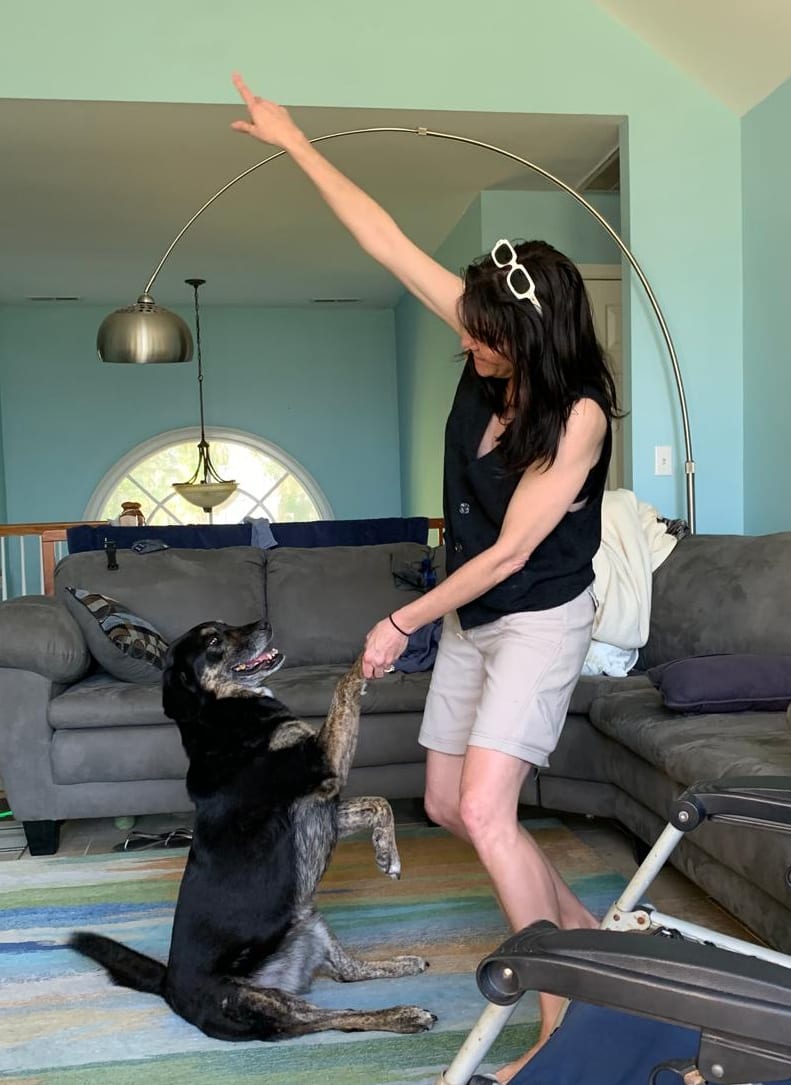
My wife Lynda and Mo the “Disney Dog”
Mo had a long-term illness (a low white-blood cell count) but was doing pretty well. My wife and I were elated, and called it “extra Mo time”.
One day a UPS truck was driving by, and Mo took off after it before I could grab her. We didn’t have her on a leash—in most cases she was well behaved.
But evidently she’d had enough of UPS and she was ready to kill that truck.
She went under the wheel.
Big bump. Four tires clamped down and slid on gravel.
Silence.
I ran to her.
I had gone into first-responder mode.
When shit happens, I become extremely clear. I take action. I get shit done. My emotions aren’t really there. I’m just doing what has to be done.
In that moment, the machine runs first. The human comes after.
I asked my neighbor to stop my wife at the front door, tell her not to come.
It was a sight no one should ever have to see.
I was with Mo when she died, telling her I loved her and it was okay to go.
The UPS driver had gotten out. He was a black guy driving into a white Southern neighborhood, and he just killed somebody’s dog.
He was beside himself, just standing there, couldn’t function. He felt horrible about it. He may have been in shock.
All my neighbors had come out pretty quick.
He said:
“She just came outta nowhere…”
What I love about Charleston and my neighborhood- everybody went to him.
Not to attack him, but to make him feel OK.
I said, “It’s ok. It’s not your fault.”
My neighbors were saying similar things before I even got to him.
For a city with a history like Charleston’s (you can visit the old slave market building downtown if you want)…
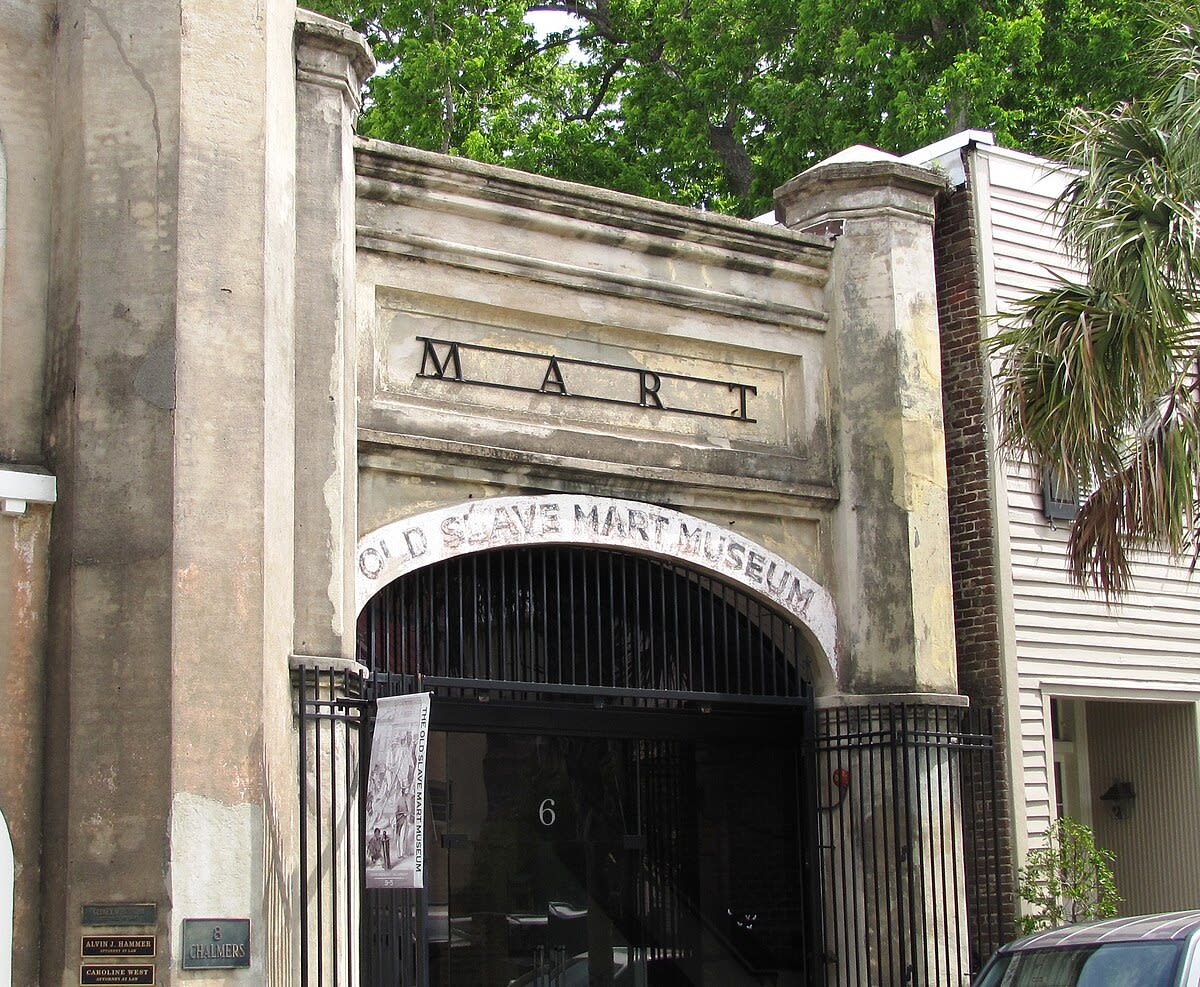
For this white neighborhood to come out and say “Dude, you’re okay, it’s not your fault” meant so much to me.
I’m from the North, but have been really comforted to find that this Southern city is way more integrated than anywhere else I’ve been in the U.S. It’s not without problems, but people mix, and that makes a huge difference.
My neighbor from down the street asked if I wanted him to get his power washer for the blood in the street. At first I myself was a bit in shock. I didn’t want to be any trouble. Oh I don’t know. Then I came to my senses and said yes, that’d be great.
Because, yeah we did need to do that, but also people naturally want to help out in a crisis. It’s instinctual.
If you run a “I do everything myself” program, you’re being selfish. You’re taking something other people need: community, and the opportunity to serve and mean something.
People are most joyous when they help each other. It’s the best feeling.
A few days later, the pressure-washer’s daughter brought over a hand-drawn card. As if I needed more reasons to cry.
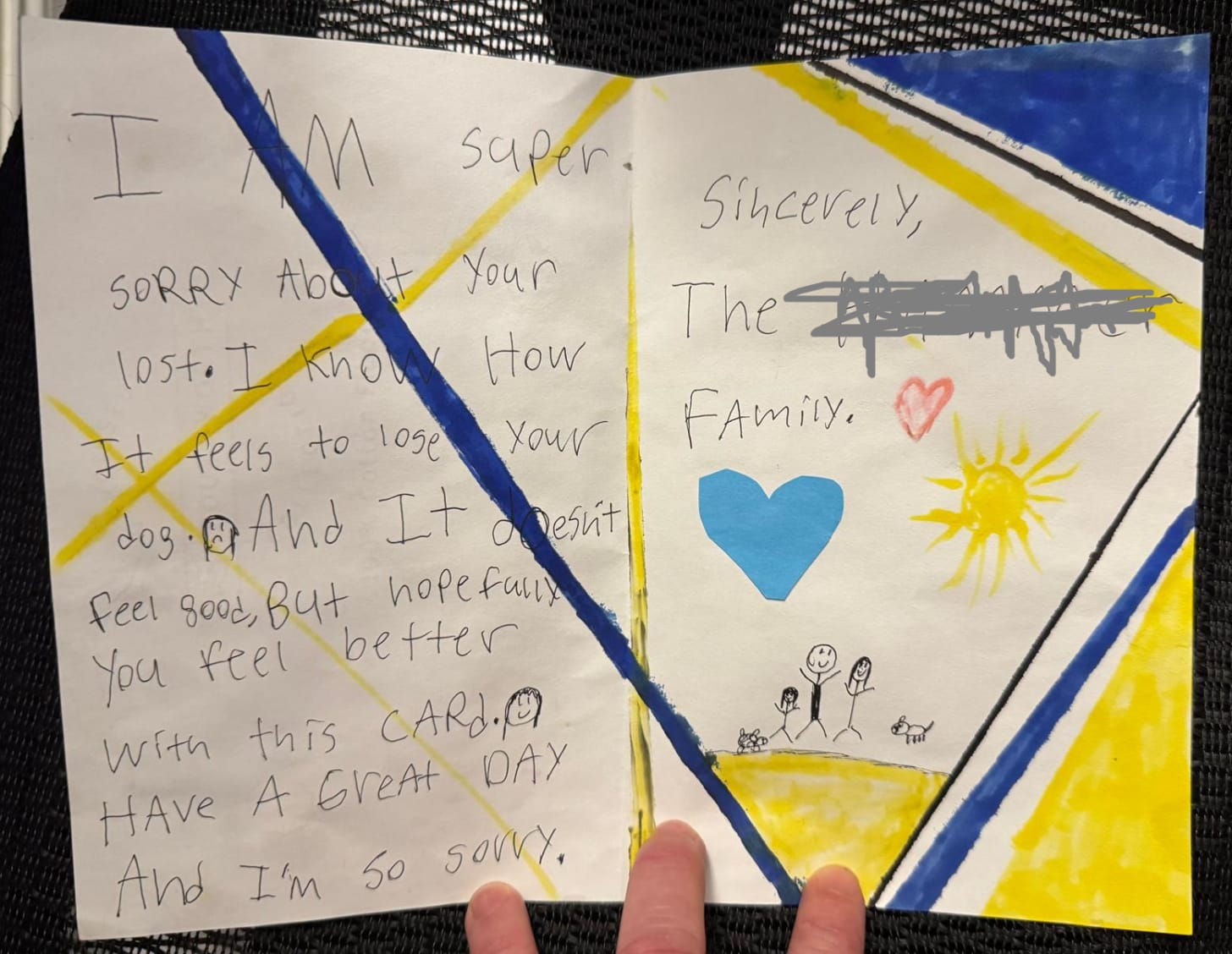
(I crossed out the family name for privacy)
That card, the thoughtfulness, still gets to me.
I had so much guilt about that day. I kept saying, “It’s my fault. I should have protected her better. Should have gotten her more training, shoulda been more cautious…”
You better believe, our current dogs—they’re trained and restrained.
I love her. I miss her. And we’ve changed our behavior. Less guilt now.
Once you see the consequences of an insufficient program, you can’t unsee.
That first responder mode—that’s the useful robot. Sometimes you need the machine to take over so you can function. I’m grateful for it.
But there are other programs running in me that aren’t so useful. I didn’t even know they were installed until something forced me to look.
Recently I got sick, and I noticed something interesting about myself.
You know guys are babies when they get sick, right? There’s something to that. I went into complete energy-saving mode. More sleep, hot baths, chicken soup. No working. No cleaning dishes, which I normally enjoy.
Didn’t want to take out the trash. Had that feeling that I wanted to be taken care of. “Lynda, can you go out and get me some…”
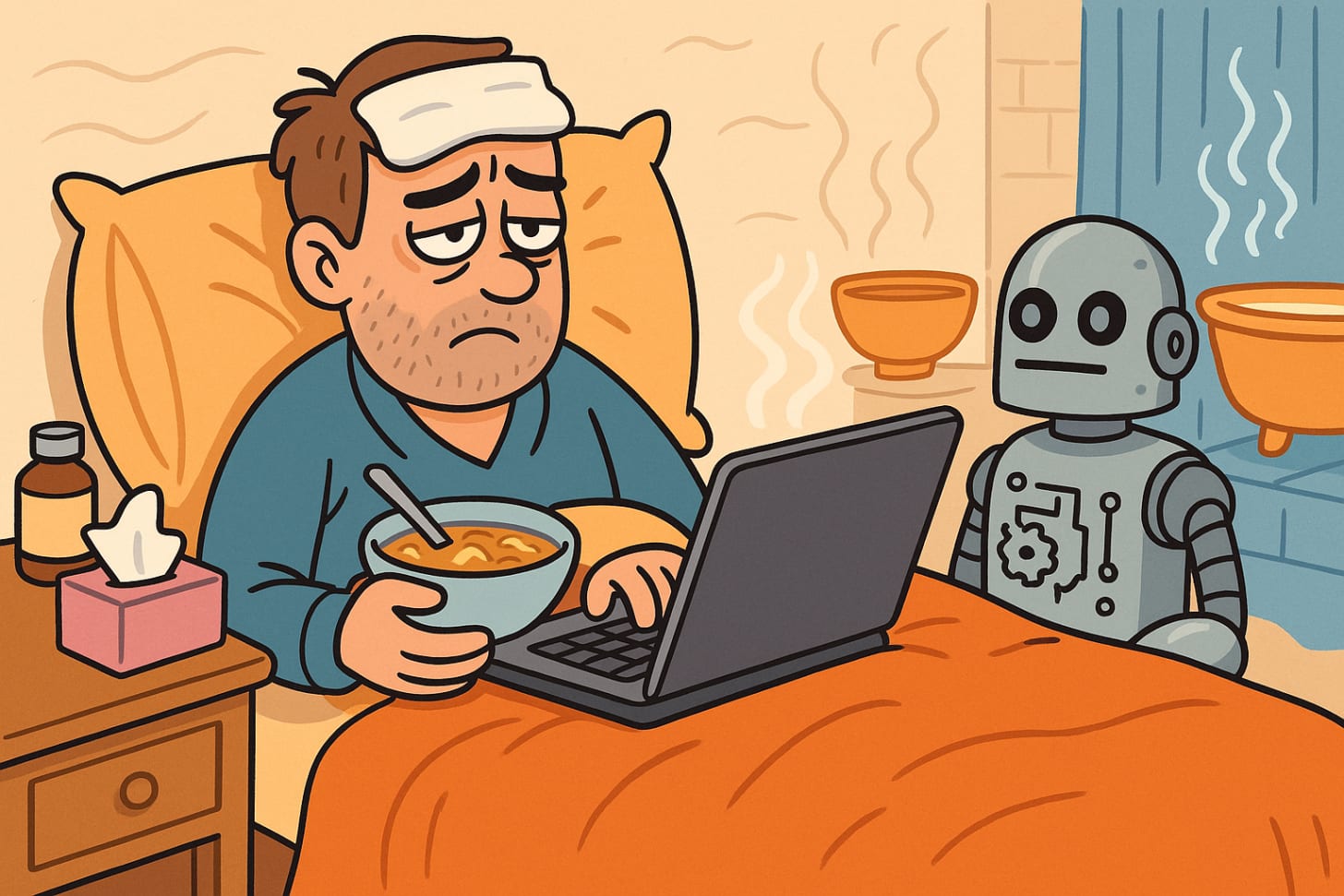
Yet I still spent six to eight hours a day while sick talking to AI about programming Python to analyze the stock market.
Because intellectual obsession and logic and research and math are fun for me. My brain is like a hot-clocked GPU that’s unhappy when it’s not maxed out. I hate boredom. I want to win. So I kept running that stuff on fumes.
Courtesy? Generosity? The positive energy I try to bring to my wife and other people? Gone. More fuel than I had.
Turns out my power-saving mode is an introverted, ambitious, ADHD dude. That’s my core code.
WORK ON COMPUTER FIGURE THING OUT.
The more realized version of me, the person who cheers people up, supports people, shows up for others, the enthusinator, if you will? That’s built. I’ve constructed it over time. And when I’m depleted, enthusinator disppears and the introversion prevails.
It’s useful to know this. It tells me what to lean on when I’m running low, and what to invest in when I have capacity. But it’s also a little disturbing that the positive adaptations we build up can evaporate when we don’t have the energy.
We’re all running code we didn’t consciously write. The question is do you even know what’s in there?
Some programs, I haven’t been able to change at all.
I hate football. Almost as much as I hate football players.
Nothing personal. (Actually… very personal!)
I know, it’s UNAMERICAN.
But it’s because I grew up small, wasn’t sporty, and the football players were the school bullies.
For you young whippersnappers, I grew up in a pre-sensitivity era. It was pretty brutal sometimes.
And because I went to a smart school—national honors, AP courses, basically doctor and lawyer yuppie larvae—our football players were smart enough to mostly use verbal abuse rather than physical. And as a very verbal guy, that was traumatizing.
Ironic twist: somebody bullied my bullies. When our team played West Dayton—Drexel—these big black guys would beat the crap out of our white yuppie larvae. Was I cheering for the wrong team? Nah, I’d never do that!
No matter how much I get over the way I was treated, I’m probably never gonna like football. I still see in those guys the people who were naturally talented, naturally popular, in ways that I was not. At least not in ways that got recognized.
I was pretty good at rock climbing. But that’s not something you can do at 16 that gets you a prom queen. We’d never heard of it in Ohio in the early 90’s!
I’m telling you this because I don’t want to pretend I’ve escaped all my programming. That wound-installed code is still running decades later. I know it’s irrational, but I can’t completely override it.
SCARRED FOR LIFE (teary emoji).
But at least I can see it now. And that’s better than running a program blindly.
So what’s the path out? If we’re all running programs—some useful, some destructive, some scar tissue—how do we become less robotic?
I think it starts with deliberately expanding your frontiers. Put yourself in situations where your certainties get challenged. Know you’re going to be uncomfortable, and do it because of that.
I spent most of my life VERY clear I wasn’t a theater person. Never occurred to me to do it.
Then I stopped excluding myself, got into a musical I had no business in, and found a community of weirdos who embraced all weirdos as family. I’ll write about that later.
“I’m not a theater person” was just a story I’d told myself so long I forgot it was a story. It was my identity
But it’s important to me to experience as much of what human beings can experience as possible.
I’ve lived in a foreign country.
Spoken Spanish on the streets in Ecuador and Tijuana.
Been in a musical.
Worked with Black communities in South Carolina through Big Brothers Big Sisters and Medicare.
Cooked enough to develop actual instincts in the kitchen.
Among other things…
Why? Because the more stuff you experience, the more you have in common with anybody you meet. You can create rapport with almost anyone. More importantly, you start to see how many of your certainties were just accidents of your particular narrow experience.
We’re only as smart as our own experience. And that’s not always that smart.
Of course, some of my programs are just stupid.
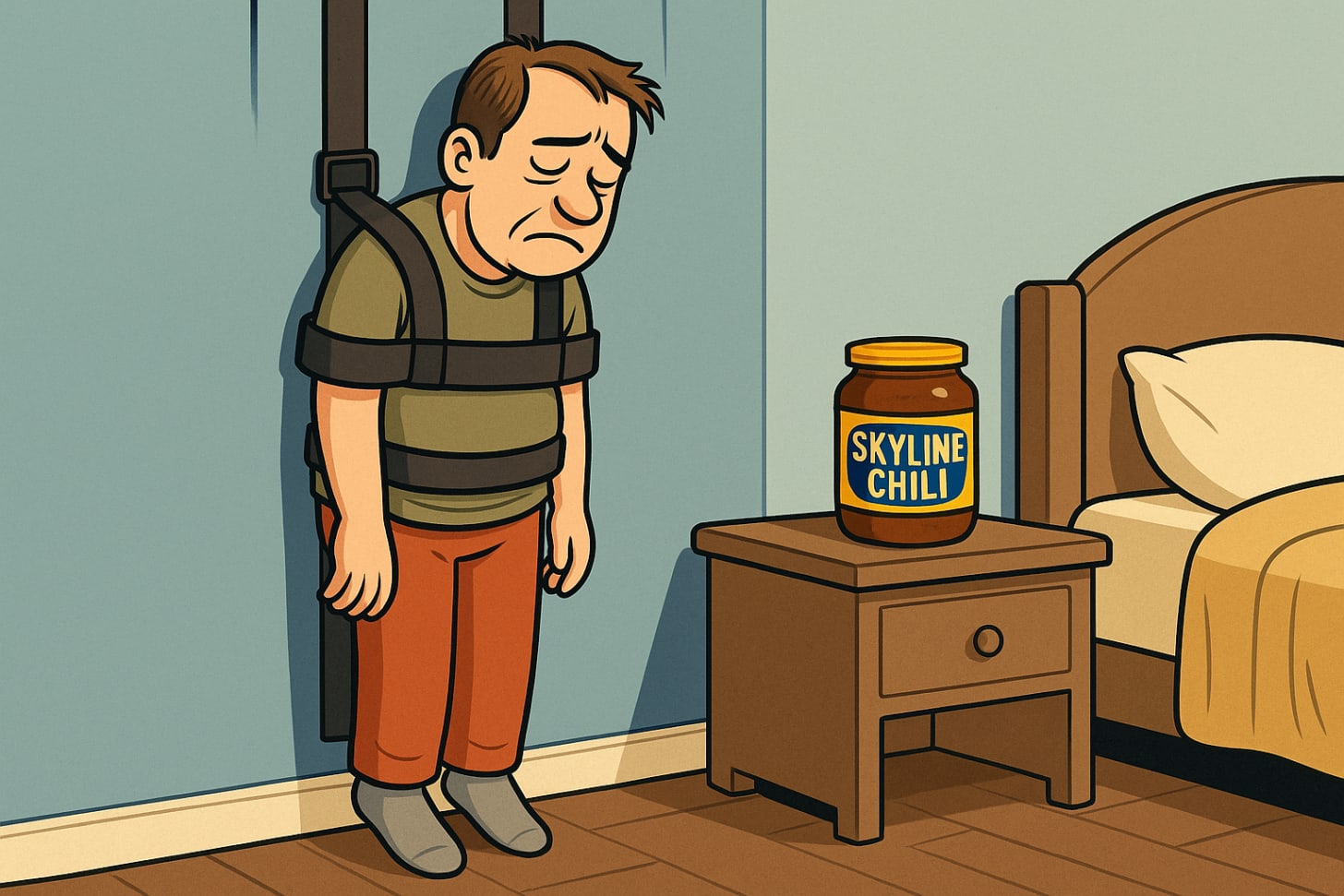
I eat Skyline Chili, a Greek-style Cincinnati chili that’s incredibly addictive, even though it destroys my gut and my sleep every time.
First bowl is great. Second bowl, I want to die. I’m sitting up at 2am trying to figure out if there’s some kind of strapping device that would let me sleep standing up.
It’s like that crazy girlfriend in the short leather skirt who makes you feel free and dangerous.
“She’s the reason I keep getting in trouble.”
You see her again, and think, “Well, maybe just one more time…”
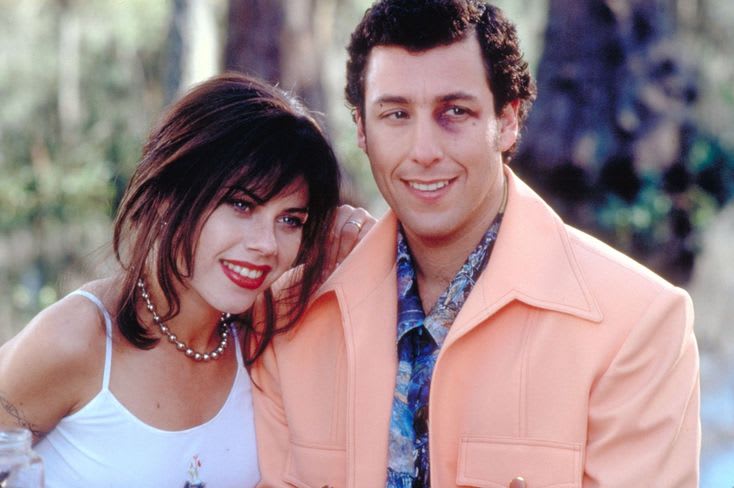
“She’s cute. I wonder why I keep getting punched!”
The other day I made Skyline at home, and when I went to clean up, our dog Sis was looking at me. She’s the dog that’ll eat anything.
I said, “No, Sis, I’m not giving you this. This isn’t good for anybody!”
Which means: I eat stuff I wouldn’t feed my dog.
I don’t know what that tells you, honestly.
I love dogs a lot, maybe myself not enough.
The robots are already here. They’re us—running our programs, following our scripts, closing questions before they’re resolved.
AI is going to replace humans who act like AI. The ones who do routine work without questioning it. The ones who optimize for metrics without asking if the metrics matter. The ones who are certain about everything and curious about nothing.
The path to survival—the path to being irreplaceably human—is the opposite of all that. Deliberate expansion. Deeper self-honesty. Staying in the question when everyone wants you to pick an answer.
There’s an old story about a farmer. His son finds a wild horse. The neighbors say, “How lucky!” The farmer says, “Maybe.” The son rides the horse and breaks his leg. “How terrible!” “Maybe.” The army comes to conscript young men but passes over the injured son. “How lucky!” “Maybe.”
There is no final judgment. There is a lot of illusory certainty.
Robots are certain of what will be. People have to say “Hmm… maybe!”
(That’s the closest I’ll ever come to Dr. Seuss.)
Maybe I can change. Maybe I can’t. Maybe this program is useful. Maybe it’s just scar tissue. Maybe I’ll figure it out. Maybe I’ll stay a fool about Skyline Chili forever. Probably. But at least I can see it now.
That’s the start:
Find your programs.
Take control of them.
Become more human.
—
Brian Carter is a keynote speaker and business consultant based in Charleston, South Carolina. He eats things he won’t feed his dog. If you’d like any leftovers, feel free to message him.
Share
Behind the Keynote: Joy, Productivity, and Profit is a reader-supported publication. To receive new posts and support my work, consider becoming a free or paid subscriber.