How Perplexity, ChatGPT, and Claude Make Educational Procurement A LOT Easier [Podcast + Prompts]
HEY if you attended the NAEP events I did in Chicago or Des Moines, welcome! The prompts are here! You found them!!!
Yes, my articles and material get pretty specific. That’s because groups like the NAEP (National Association of Educational Procurement) ask me for customized keynotes and workshops.
This year in events, I’ve done mental resilience for the Air National Guard and Air Force, sales for bottled water distributors, pushing the boundaries of success for one of the largest conferences in the world, 22 other keynotes and workshops this year, and now AI for educational procurement.
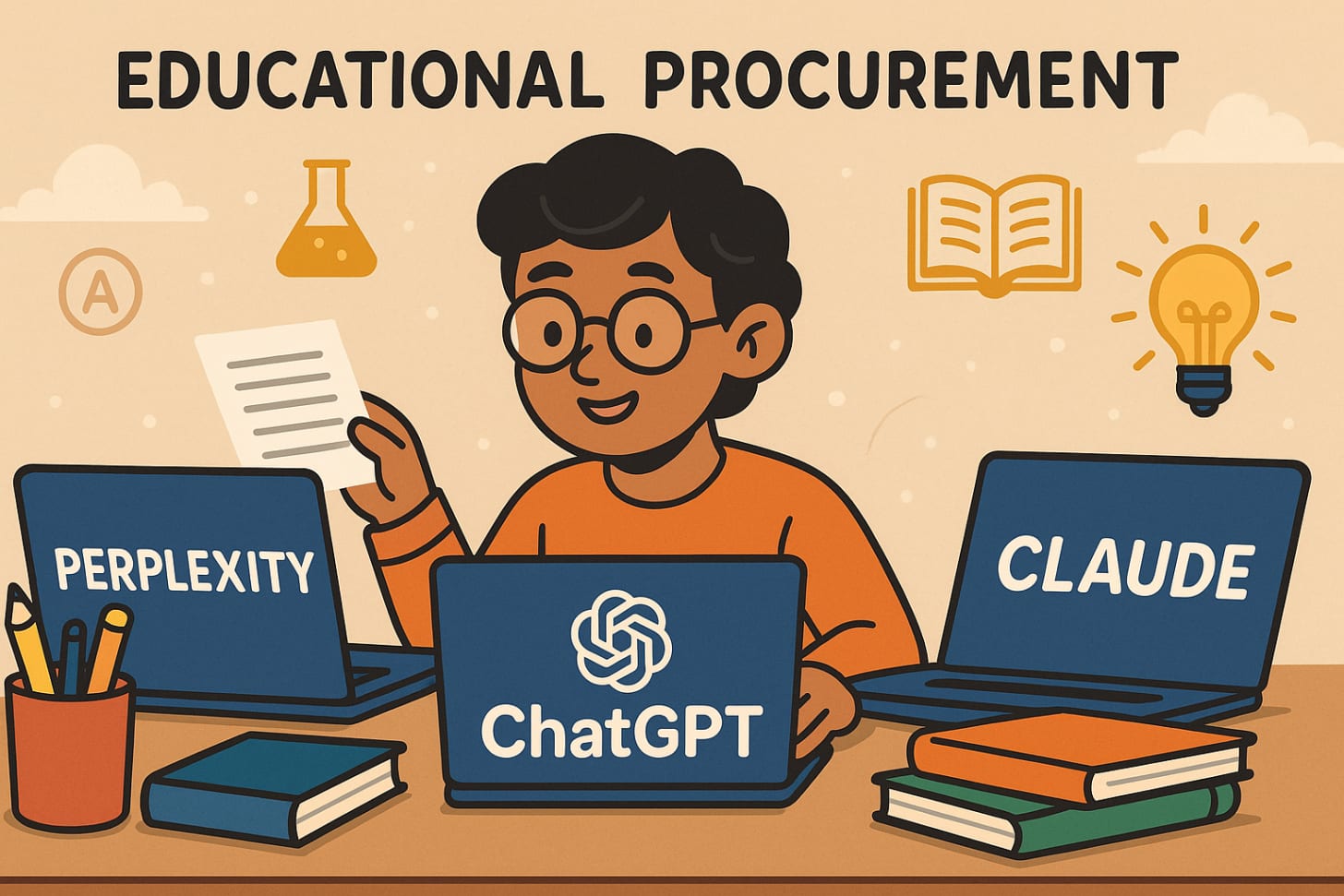
In an industry (like many, believe it or not) where some people are still moving from paper to digital, I cover both the basics and some intermediate or advanced stuff.
I’ll be releasing a number of content pieces related to this gig, and the first is a set of prompts that can be used for the entire education procurement lifecycle.
My material covered how they can use Perplexity, ChatGPT, and Claude for these tasks. This article is a demo of the prompts (unsurprisingly created from my work with all three of those AI’s).
But the videos are a little bit more interesting!
Covered below in text, here are videos of the simple intro and the deeper dive.
Subscribe now
Share
How Can AI Help?
The educational procurement workstream is this:
Need Identification → Department realizes they need something
Research & Sourcing → Find and vet potential suppliers
Specification & RFP Creation → Write detailed requirements
Communication & Negotiation → Stakeholder updates, vendor communications
Contract review, PO, delivery, payment
First I’m going to give you a simple 3-part intro, and then further down, if you want more, is a deeper dive that covers the whole workcycle.
The Simple Demo
A practical demonstration of three AI tools (Perplexity, ChatGPT, and Claude) for procurement professionals, focusing on vendor research and email writing tasks.
Perplexity - Vendor Research
Identified top 3 lab equipment suppliers for US universities (Thermo Fisher Scientific, VWR International/Avantor, and LabSource)
Compared vendor reviews and complaints across suppliers
Attempted pricing comparisons (though detailed pricing info wasn’t publicly available)
Showed both quick search and deeper research modes
ChatGPT - Email Writing
Generated professional vendor rejection emails with varying tones (formal, warm, direct)
Created status update emails with different formality levels
Demonstrated a humorous “bad email” example showing what NOT to write
Showed how to adjust tone based on audience (boss as friend vs. formal corporate setting)
Claude - Document Analysis
Summarized a complex vendor proposal into concise bullet points
Identified what questions to ask vendors based on their proposals
Provided both positive and critical assessments of vendor communications
Generated vendor response examples
These AI tools can help procurement professionals with vendor due diligence, professional communication, and document analysis - saving time while maintaining quality and professionalism.
Now, the Deeper Dive!
For reference, here is the actual perplexity chat where I demo’d them.
Here’s what I was able to get in my research, along with the prompts I ran in the demo:
The Higher Education Procurement Professional Profile
Who They Are:
Titles: Procurement Officer, Purchasing Agent, Procurement Specialist, Buyer
Team Size: Often small teams (1-5 people) managing large institutional needs
Education: Bachelor’s degree minimum, often in business, supply chain, or related fields
Experience Level: Mix of seasoned veterans and newer professionals learning complex systems
What They Know:
Core Competencies:
Regulatory compliance (federal, state, institutional policies)
Negotiation and contract management
Strategic sourcing and supplier evaluation
Budget analysis and cost management
Market research and pricing trends
Systems & Tools:
ERPs (Enterprise Resource Planning systems)
eProcurement platforms
Spreadsheets (heavy Excel/Google Sheets use)
Cooperative purchasing systems
Knowledge Gaps:
Limited technical expertise in specialized categories (lab equipment, EdTech)
Often procuring products/services they’ve never bought before
Becoming “instant experts” on unfamiliar categories
Their Biggest Challenges:
Research Overload & Time Constraints
Processing thousands of purchase orders annually with limited staff
Conducting vendor due diligence for unfamiliar products
Market research taking weeks when decisions needed in days
Specification Paralysis
Writing detailed RFPs for products they’ve never purchased
Creating technical specifications without subject matter expertise
100+ page RFP responses to analyze and compare
Communication Burden
Managing stakeholder expectations across decentralized departments
Stakeholder engagement as top challenge
Vendor communications, rejection letters, status updates consuming hours daily
Compliance & Risk Management
Navigating complex federal, state, and institutional regulations
Ensuring supplier diversity and sustainability requirements
Contract compliance tracking, difficulty locating agreements
Resource Constraints
Increased stress and burnout
Larger workloads, shrinking budgets, and rising demands
Demo Prompt Strategy: Full Procurement Lifecycle
It’s all in text here, or if you prefer, here’s a Google Doc, which you can export as a PDF or Word Doc, or just print.
Scenario: Emergency Lab Equipment Procurement
The Chemistry Department’s mass spectrometer failed unexpectedly. They need a replacement within 60 days. Budget: $150,000. You’ve never purchased this equipment before.
STAGE 1: Need Identification
Perplexity Prompts:
**Simple:**What is a mass spectrometer used for in university chemistry labs and what are the key specifications I should know as a procurement officer?
**Complex:**I’m a university procurement officer who needs to purchase a mass spectrometer for our Chemistry Department with a $150,000 budget. I’ve never bought this equipment before. What are the:
Essential technical specifications I need to understand
Top 3–5 manufacturers in this price range
Typical lead times for delivery and installation
Key questions I should ask the department to refine requirements
STAGE 2: Research & Sourcing
Perplexity Prompts:
**Simple – Vendor Discovery:**Top manufacturers of mass spectrometers for university research labs under $200,000
**Complex – Comprehensive Due Diligence:**Research Thermo Fisher Scientific as a potential supplier for university lab equipment:
Company financial stability and recent news (last 12 months)
Higher education client base and references
Delivery and installation capabilities in the Southeast US
Service and maintenance support options
Diversity certifications (women-owned, minority-owned, veteran-owned)
Sustainability initiatives and green procurement compliance
**Complex – Market Intelligence:**Current market conditions for mass spectrometer procurement in 2025:
Average pricing trends for mid-range research-grade units
Supply chain issues or delivery delays affecting lab equipment
Emerging technologies or models released in past year
What other universities are purchasing (industry benchmarks)
Recommended warranty and service contract terms
**Simple – Compliance Check:**Federal procurement regulations for lab equipment purchases using grant funds
STAGE 3: Specification & RFP Creation
ChatGPT Prompts:
**Simple – RFP Outline:**Create an RFP outline for purchasing a mass spectrometer for a university chemistry lab. Budget: $150,000. Include standard sections.
**Complex – Complete RFP Generation:**You are a university procurement specialist creating an RFP for a mass spectrometer purchase.Context:
Public university in Charleston, SC
Chemistry Department research use
Budget: $150,000 (federal grant funded – requires Uniform Guidance compliance)
Required delivery: 60 days from award
Installation and training requiredCreate a complete RFP including:
Project overview and background
Technical specifications (based on typical research-grade mass spec requirements)
Vendor qualifications (must include insurance requirements, past higher ed experience)
Evaluation criteria with weighted scoring (price, technical specs, service/support, delivery timeline, sustainability)
Submission requirements and deadline
Terms and conditions (include supplier diversity language, sustainability requirements)
Timeline from RFP release to contract awardFormat: Professional RFP document, 400–500 words, bullet points for clarity.
**Complex – Evaluation Scorecard:**Create a vendor evaluation scorecard for comparing 3–5 mass spectrometer proposals.Include weighted criteria for:
Technical specifications match (30%)
Price and total cost of ownership (25%)
Vendor experience with higher education (15%)
Service and support capabilities (15%)
Delivery timeline (10%)
Sustainability/supplier diversity (5%)Format as a table with scoring instructions and space for notes.
STAGE 4: Communication & Negotiation
Claude Prompts:
**Simple – Vendor Outreach:**Write a professional email to 4 vendors inviting them to submit proposals for a mass spectrometer purchase. Include submission deadline and key requirements.
**Complex – Stakeholder Communication Suite:**You are a university procurement officer managing a mass spectrometer purchase for the Chemistry Department.Create 3 professional emails:
Initial stakeholder update to Chemistry Department Chair
Vendor RFP solicitation to 5 qualified suppliers
Budget justification memo to CFOEach email should be under 300 words.
**Complex – Proposal Analysis:**I received 4 vendor proposals for a university mass spectrometer purchase (100+ pages each).Analyze and create a comparison summary covering:
Technical specifications comparison
Pricing breakdown
Delivery timelines and installation requirements
Vendor qualifications and experience
Service and support commitments
Risk factors or concerns
Recommended vendor with justificationPresent as: Executive summary, comparison table, recommendation paragraph.
**Simple – Rejection Letter:**Write a professional, courteous email declining a vendor’s proposal for university lab equipment. Thank them for their time and encourage future participation.
STAGE 5: Contract, PO, Delivery, Payment
Claude Prompts:
**Simple – Contract Review:**Review this contract clause for a university equipment purchase and identify any potential risks or concerns related to liability, warranty, or payment terms.[Paste sample contract clause]
**Complex – Contract Negotiation Points:**You are reviewing a vendor contract for a $150,000 mass spectrometer purchase for a public university.Analyze this contract for:
Payment terms
Warranty coverage
Installation and training obligations
Service response times
Indemnification clauses
Termination provisionsProvide:
Risk assessment for each area
Specific negotiation talking points
Suggested contract language alternativesFormat: Bullet points, procurement-officer-friendly language, cite specific concerns.
**Complex – Delivery Tracking Communication:**Create an automated email template series for managing equipment delivery and acceptance:
Vendor confirmation email
Department preparation email
Delivery day coordination email
Acceptance sign-off requestEach email should be concise, action-oriented, with clear next steps.
Cross-Functional Bonus Prompts
Training & Documentation (ChatGPT):
**Complex – Process Documentation:**Create a step-by-step guide for new procurement staff on “How to Purchase Specialized Lab Equipment at [University Name]”Include:
When to use RFP vs sole source vs cooperative contract
Required approval thresholds
Compliance checkpoints
Stakeholder communication best practices
Common pitfalls to avoid
Helpful resources and contactsFormat: Bulleted procedure with decision tree, 500 words max, new-employee-friendly tone.
Budget Analysis (ChatGPT):
**Complex:**I need to justify a $175,000 lab equipment purchase to our CFO when we budgeted $150,000.Create a cost-benefit analysis memo including:
Cost breakdown comparison
Total cost of ownership over 5 years
Cost of NOT purchasing
Alternative options considered
Risk mitigation if we delay purchase
ROI calculation for research outputFormat: Executive memo, data-driven, persuasive but factual, under 400 words.
Market Research (Perplexity):
**Complex – Benchmarking:**What are peer universities (public, R1, 15,000–20,000 students, Southeast region) spending on laboratory equipment procurement annually?Include:
Average spending per research lab
Common procurement strategies
Emerging trends
Recommended service contract terms
Typical replacement cycles for major equipment categories