I Beat the Market Last Month by 32%
DISCLAIMER: I am not a financial planner or certified financial anything. I am more certifiable than certified. None of this is investment advice. Please consult a financial expert or planner before making trading decisions, and be vewy, vewy careful.
In this article, we’re going to cover a lot:
How I’ve been beating the market
Why I failed so much at first
What I learned
The mistakes that cause most active traders to fail (I made/make them too!)
What successful traders do differently- according to research
Also, sometimes I ramble. KNOWWHUTIMEAN?
…
Man I’m tired.
It might be:
The new allergy medicine I’m trying that absolutely sucks
Traveling to Vegas for a corporate speaking gig the last three days
Also doing my normal jobs and actively trading every day
And just being 52 years old? BUT A SPRYYYYY 52!!!
Or a case of the Mondays on a Friday
It’s probably all of that and more.
It’s probably the aliens beaming x-rays at me from Uranus. LOL. This allergy medicine makes me loopy, too.
I I had any energy I would be ebullient. Wait lemme look up what that means.
e·bul·lient: Cheerful and full of energy.
Yes, if I had energy I would be full of energy.
Enough rambling, dummy!
So, I’m going to show you shots from my Robinhood account- it’s my small one, not my Vanguard IRA. Robinhood is the one I created this year to mess around with stocks for the first time.
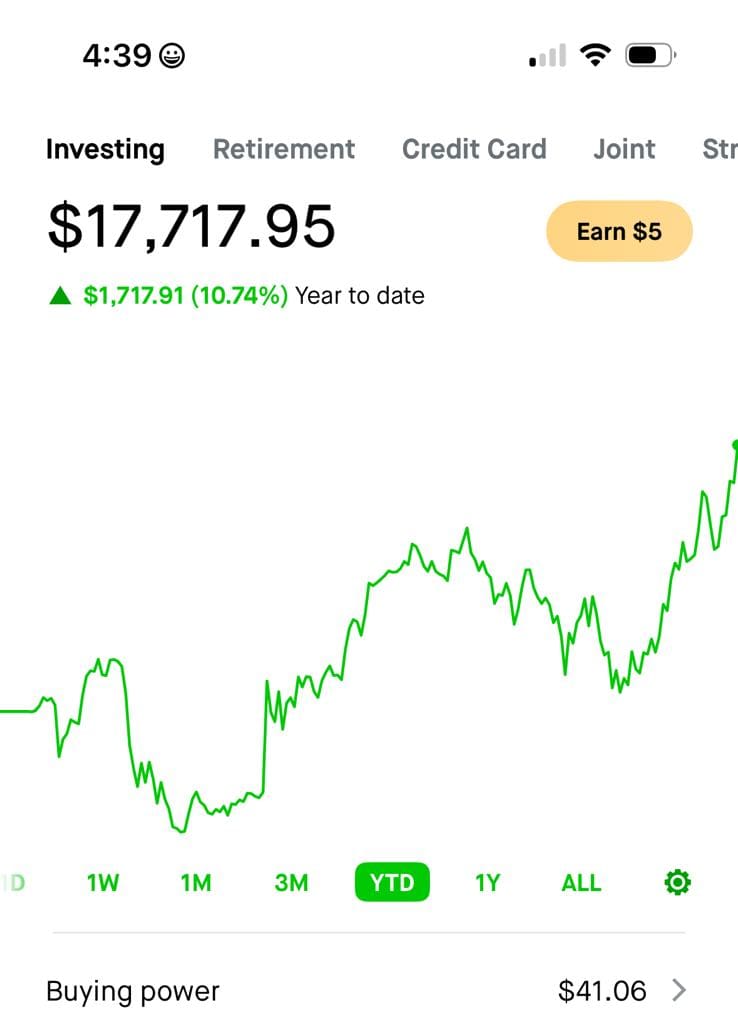
You can see there have been some ups and downs as I made mistakes, had to deal with the tariff impact which has been pretty historic, and so has the market’s response to it.
I started with $16,000 in there. And yeah, I’ve only made $1,718, but my Vanguard is up more because it’s more money (but not as high a percentage because I have money market funds there as well, being cautious, and all).
And yes, I haven’t beaten the market YTD, because I just started trading in Feb.
The more important thing is the percentage. Because of compounding.
(I’ve seen people fail over and over in business because they were looking at the wrong numbers. Rates are better than absolute numbers is one big lesson.)
Compounding, as you may know, is nuts.
For example:
The Nasdaq (NDX, QQQ, VOO, VTI, aka the “major indexes”) might double an investor’s money in four years, assuming things continue as they have.
But an investor that averages a 0.1% return per day for three yearshas already doubled it, one year sooner.
If one could average 0.3% gain per day, the account would double in less than one year.
That’s a big IF.
Comparing my performance to the indexes; initially I tried to beat the S&P500, but the Nasdaq (NDX) has done better so I raised my bar to beat that.
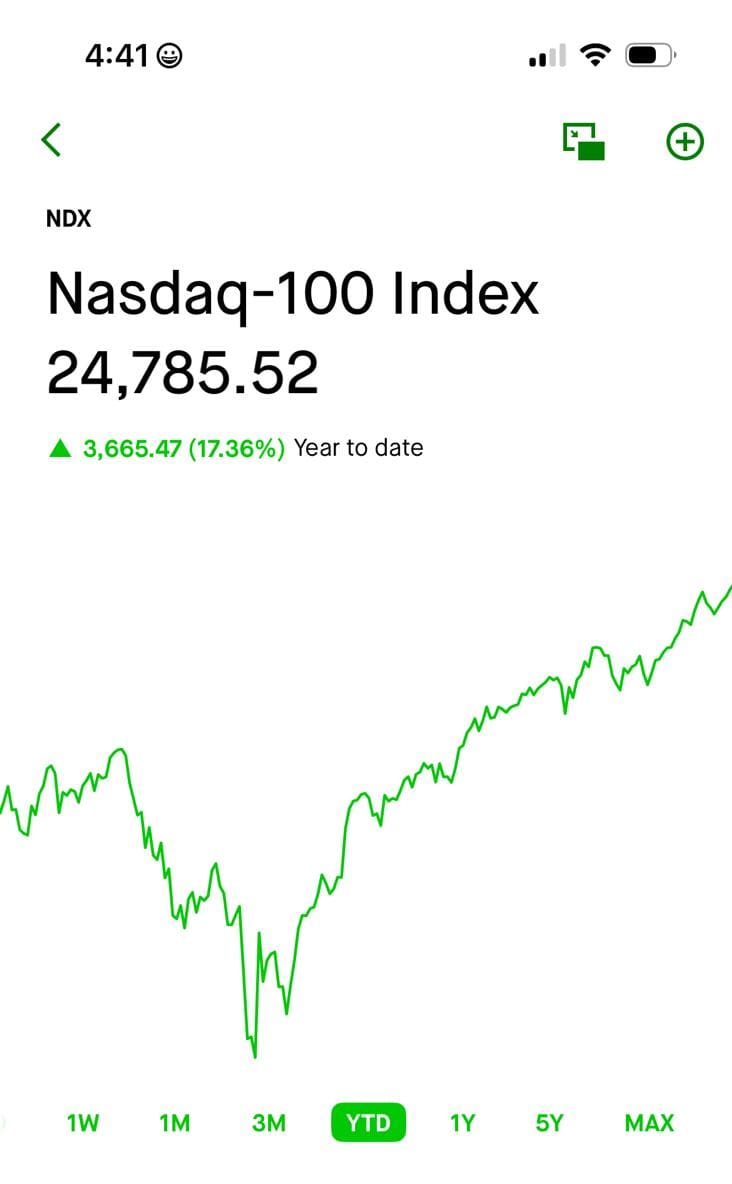
The NDX is still beating me year-to-date, but I’ve caught up and exceeded its pace.
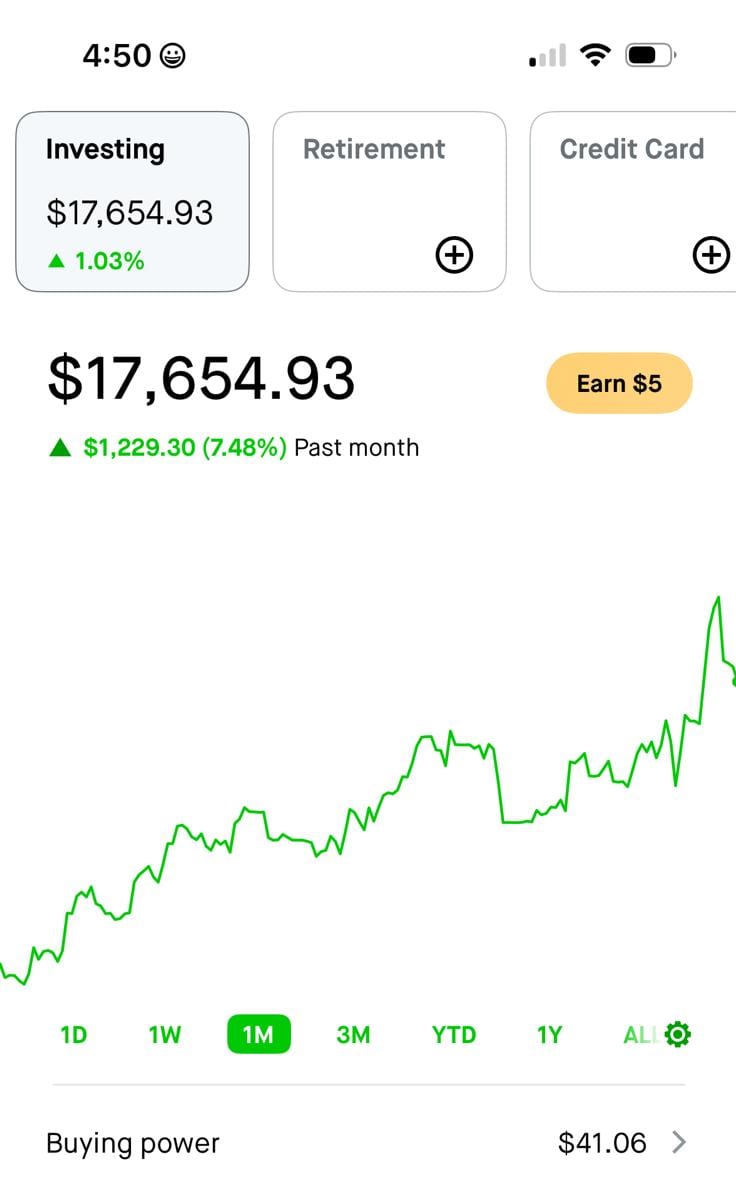
That was mine, and here’s the Nasdaq:
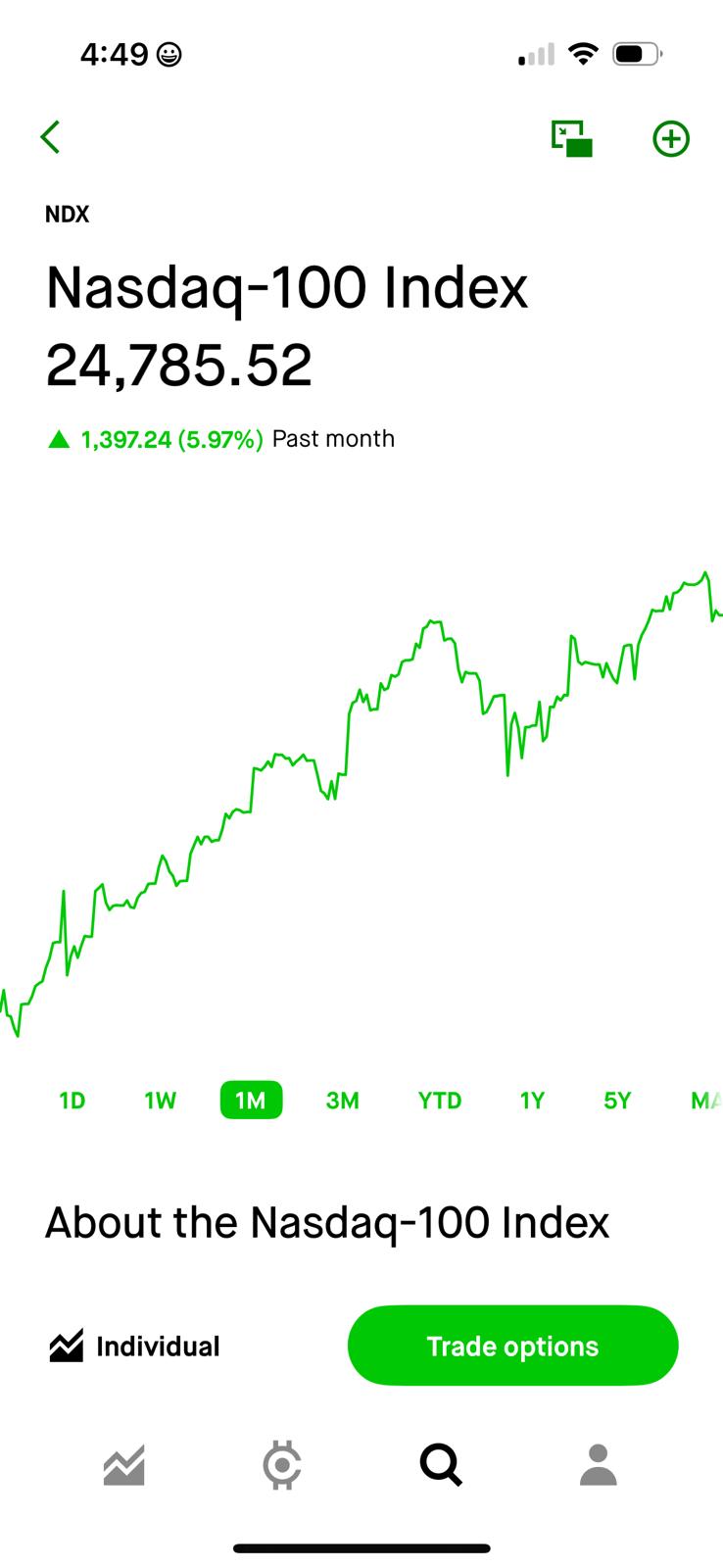
So that’s where I have 32% higher growth pace right now, beating the market.
And yeah, it’s only a month. But it’s a very statistically unlikely one; meaning that:
Either I figured something big out, or
I’m in for a rude awakening.
Maybe if I continue to do this for three months I’ll think it’s something.
And because I ask him to, Claude keeps giving me shit about how it might only work in this regime and time period, and I need to backtest it on 2020, 2022, 2000, 2008 etc.
And I will. Because the last month doesn’t matter if it’s not sustainable.
And I almost didn’t publish this because I didn’t want to be wrong or look stupid or sound braggy or any of that self-critical junk.
I wrote it because it helped me think, and I published it because Claude said it was still valuable. AND I DO EVERYTHING CLAUDE SAYS.
How Can I Make Sure This Performance Continues?
My focus is on creating as perfect a portfolio as I can. Anyone can be great for a short period of time. But how can you increase your chances of being great for a long time?
I look at:
Returns
Risk adjusted returns
How the various stocks and ETFs correlate
Which ones are up when the others are down
And MORE
Subscribe now
I’m managing risk- these are the risks that are most important to me:
Losing money: Avoiding stocks that are likely to go down.
Instability: Avoiding stocks whose returns aren’t worth their volatility.
Emotional stress: Active trading can be very stressful. Two things here:
(1) Creating a portfolio that is unlikely to have negative days; what I have now has only had three negative days over the last month, and
(2) Making sure that the portfolio overall does lose much on the days it loses, but still makes a lot when it’s positive.
Mediocrity and poverty: Making sure I compound my money as much as possible within the bounds of safety, beating inflation which is likely to get much worse over the next few years, ensuring that my wife and I can retire comfortably.
I’d rather go up than down. You?
All of the above is possible with enough of the right analysis, if you analyze stocks the way that professional quants do at big funds.
Anyhow, I promised you the how of it… here’s my process, and what has gone into it:
The absolute number one most important thing, because you can’t get there without the following: Learn new things, like trading, by using AI.
Ask Perplexity 20 questions a day. It would take me so long to pull out the 100s of questions I’ve asked it over the last 8 months, I’m just not gonna do it. Here are a few though:
”Give me an in depth intro to algorthimic trading and what retail traders can use to test it”
”Can you summarize this article?” (It’s about crypto momentum over weekends)
”Can you still get a good old sharpes rifle” (oops, off topic, but you can!)
This learning process has taught me python programming (well, at least AI-assisted programming), the stock market, statistics, economics, advanced Google sheet formulas, and exactly what it means when my dog barfs up a pound of grass.
But AI still hasn’t explained to me why one of our dogs ate a leather glove, so it has limitations. Fun gross fact: we still have the glove, and my wife still wears it when it gets cold out.
As many people share: ask AI to be a devil’s advocate. Don’t let it butter you up too much. Ask it for context. Ask it for ideas you haven’t thought of. Ask it what you should ask.
To win consistently: Have a system. There should be as little guessing as possible, and quantifiable things reign. Soft, qualitative ideas can be a factor, but you need to see them borne out in the metrics. We humans are just too good at rationalizing, and we’re suckers for a story. Let the metrics be the story.
To make money: Scour the market for the best return stocks and ETFs
To ensure they’re solid long term, not just flashes in the pan: Analyze them for risk-adjusted returns, price linearity, correlation to major polar assets like the Nasdaq, Gold, Crypto, Inflation, institutional ownership, earnings per share, and so on.
To beat the indexes: Compare their performance on many factors to NDX and IAU.
Put it all together: Allocate to the winning stocks and ETFs according to a score that combines all the foregoing factors.
Monitor and learn: Watch the portfolio daily, detect microregimes, and adjust holdings to reduce day-to-day whipsawing.
Don’t freak out: On the negative return days, check out the big gainers for new candidates to analyze.
Learn to watch the portfolio go up and down without freaking out. This is the toughest one. It’s taken me making the same danged panic selling mistakes repeatedly to learn to just wait a couple days.
I’d heard so much advice to let winners run and kill losers quickly that I overdid that- the key thing is knowing if its current behavior makes it a loser, or if it’s normal.
Holding is important: Understand that some stocks mostly go up from market close to market open, and then drop throughout the day, which can make winners look like losers.
The times I’ve sold everything out of panic, it was harder to get back to a good portfolio mix and allocation level. But I think I know why- if you only buy the ones that look good today, there’s a good chance they’ll be down tomorrow, which can make it seem like you chose the wrong ones.
It’s better to conceptualize a good mix and buy all of it at once, then tweak.
Create a system to detect whether each stock’s negative performance in a day is within normal limits. It’s just the widely-recommended 2x standard deviation level. But even one superweird day can be normal for a month-long period.
Only if I see two or three days in a row like that do I start to doubt a formerly rock solid momentum stock and take a deeper look.
Share
Some Contrary Things I’ve Learned This Year
And I have contrary views on a lot of things you’ll hear most retail traders say. And remember, most of them lose money or maximum make what the indexes do, so what do they know?
You don’t have to hold a stock forever. In my world, which is about momentum trading, you shouldn’t. Stocks aren’t marriages, and even if they were, you don’t have to stay in a bad one. These days, I hold for at least a few days, and the best ones can run for weeks.
You don’t have to find temporary losers and hope they come back like Rocky Balboa or something. They’re losing for a reason. They may never come back. This whole “finding undervalued assets” strategy is well-documented to have worked amazingly when Buffet and Munger were coming up, but less and less successful over the last 20 years.
‘The market” is not the whole market. There are thousands of stocks and ETFs, and if you analyze them, you’re effectively panning for gold, and you’ll find it if you know what to look for.
You can’t time the market? Wrong. Yes, you can. The past doesn’t predict the future? Absolutely it does. “If we don’t learn from the past, we’re doomed to repeat it.” Most people agree with that one.
Tell me how much you’d agree if you were in an abusive relationship, totally fed up, and their argument for staying was: “I can change! You don’t know I’m not going to change. Believe in me!”
Buh-bye.
Winners are more likely to win again than losers. Losers tend to stay losers. Don’t adopt a rescue stock. Don’t be a doormat. Buy a winner. Our brains are a stunningly sophisticated and powerful system of emotions and logic, but for investments, I have to turn off the emotion.
The best known research concluded that reallocating your investments monthly is better than weekly, or quarterly, or annually. What I find, and have modeled out with AI and python programming, is that reallocating weekly could triple the gains, but only with a system.
Most People Shouldn’t Do This
Most people shouldn’t actively trade (as you probably know, most of them lose money or barely make any), but some people can be great at active trading, and you’re doing them a disservice to tell them not to- I’ll go into what makes these traders different later in this article.
There are probably two types of people that want to actively trade (1) Impatient people who want a shortcut and will lose money (2) Rebels who have the smarts and sticktuitiveness to succeed.
And neither will listen to you anyway.
I wrote in the past about one reason I failed at first, and it’s also the reason I have a trading advantage now.
In brief, I was so mad at the market for dropping in April, I just wanted to beat SPY (S&P500). And I didn’t want to trade it. I got really good at finding the stuff that wins when the market goes down.
But then I couldn’t win when it went up!
So I had to change my system to win in both risk-on and risk-off situations.
I also tried about 20 different systems-
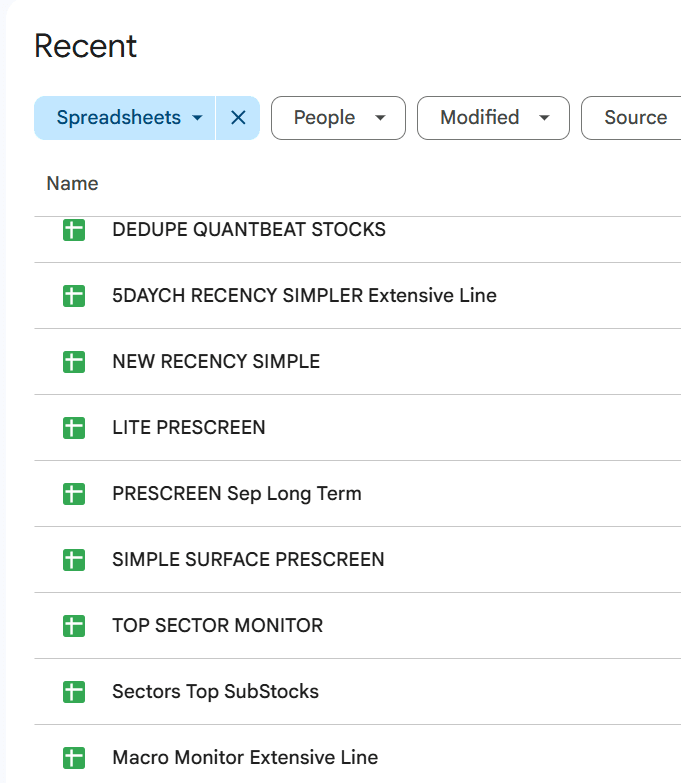
I have literally dozens of rejected spreadsheets that worked some or didn’t work, but always taught me something.
These things always have 80-250 columns of numbers and calculations in them. Even AI told me to keep it simple and be consistent. But I love to explore ideas, even if only 25% of them end up being keepers. Those 25% are gold.
None of my ideas are originally, probably- but I’m really good at combining old ideas into new things.
Now, what makes a trader able to achieve these things?
I value both safety and crazy achievement. I’m like a Volvo driver who wants to pass every car on the road. I’ll try to learn to dodge bullets (no I won’t), but I’ll do it wearing a bullet proof spacesuit!
—
This next part is from Perplexity, on what good and bad traders do.
Why Most Active Traders Fail
First let’s talk about why most traders fail. Then we’ll get into who the winners are and what they do.
Most traders fail due to a consistent mix of behavioral, strategic, and psychological mistakes, often amplified by market structure and cognitive biases. Here is a breakdown of the most common reasons why bad traders lose money:
Emotional Decision-Making
Reacting to fear, greed, or FOMO instead of a consistent process leads to impulsive and undisciplined trading.
Revenge trading—trying to quickly recover losses usually compounds errors and losses.
Poor Risk Management
Overleveraging positions amplifies potential losses.
Risking too much on a single trade or neglecting stop-loss limits allows small losses to become catastrophic.
Not having predetermined exit plans or failing to honor stop-losses, hoping trades will “turn around”.
Lack of Education and Preparation
Minimal market research and inadequate strategy result in random, “gut-feeling” trades.
Ignoring the real market behavior and relying instead on tips, rumors, or untested setups.
No Trading Plan or Discipline
Trading without a clear plan for entries, exits, and risk management prevents improvement or consistency.
Changing strategies frequently or abandoning discipline after losses disrupts long-term gains.
Overtrading
Excessive number of trades, often driven by impatience or chasing losses.
Studies show losing traders place 4x more trades than winners, with frequent traders having up to an 80% loss rate.
Cognitive Biases and Overconfidence
Survivorship bias and belief in being “above average” lead to persistent unprofitable behavior.
Early small wins create overconfidence, while losses are interpreted as bad luck rather than systemic risk.
Neglecting Fundamentals and Risk Ratio
Not understanding leverage, product risk, or basic market structure.
Misjudging the risk/reward ratio and exposing capital to unnecessary danger.
Overexposure and Chasing the Market
Putting too much capital into single trades or hot sectors out of emotion or recent trends.
Following or copying trades from others without understanding the rationale or context.
Final Behavioral Mistakes
Ignoring the need for ongoing education and adaptation.
Quitting quickly after initial losses or stubbornly continuing without learning from mistakes.
Letting emotions run trading decisions, particularly after losing trades leading to greater risks.
In summary, failure in trading is overwhelmingly caused by lack of planning, poor emotional discipline, excessive risk taking, and underestimation of market complexity. Most who do not address these issues either lose their account or leave trading within a couple of years.
Profile of Successful 8% Monthly Performers
The rare traders who achieve such extraordinary returns typically share specific characteristics:
Education and Background
Financial/quantitative education: Most have degrees in finance, economics, mathematics, engineering, or computer science
Continuous learning commitment: Professional development through courses, certifications (CFA, Series 7), and constant market study
Technical expertise: Deep understanding of quantitative analysis, risk management, and statistical modeling
Professional Approach
Institutional experience: Many worked at hedge funds, proprietary trading firms, or investment banks
Systematic methodology: They follow rigorous, backtested strategies rather than intuitive trading
Risk management focus: Employ sophisticated position sizing and risk controls
Time Commitment
Successful traders dedicate substantial time to their craft:
Active trading: 0.5-2 hours daily for execution, focusing on high-probability setups
Preparation and analysis: 1-2 hours daily for market review, planning, and strategy refinement
Continuous improvement: 5+ hours weekly on education, backtesting, and performance analysis
Total commitment: 15-20 hours weekly minimum, with newcomers often spending 40+ hours initially
Distinguishing Characteristics
Emotional stability: Ability to handle significant drawdowns and maintain discipline
Pattern recognition skills: Exceptional ability to identify short-term price inefficiencies
Capital advantages: Often trade with substantial capital ($100K+) to generate meaningful absolute returns
Technology and tools: Access to professional-grade platforms, data, and execution systems
So you can see, it’s not for the faint of heart, those “bad at maths”, impulsive people (although I am ADHD and have figured out some modicum of discipline, mostly through painful losses), busy people, etc.
That’s it! More later!
Subscribe now
Share