I Built a Self-Care Keynote to Help Wyoming School Superintendents
There’s a moment — maybe you’ve had one like this — where it hits you that your entire life might be one giant interdisciplinary case study.
For me, it was during a self-care workshop I built this year for a group of Wyoming school superintendents.

Wyoming is wild, beautiful… and REALLY freakin’ windy.
It was funny. It was interactive. It was healing.
And I realized halfway through: this wasn’t just a keynote.
It was an AI-assisted leadership model, backtested on comedy, stress-tested with real humans… and carrying all the same principles as my stock investing strategy.
The Algorithm of Attention
Let’s back up.
When I started doing stand-up, I didn’t trust my instincts.So I built a spreadsheet. (My wife says, “Of course he did.”)

Yes, I did a teeny bit of prop comedy. But I mean, I wrote a SONG!
Each joke was logged with:
Duration
Topic
Laugh strength (1–10 across multiple shows)
Flow position in the set
Probably more nerdy columns I’ve forgotten
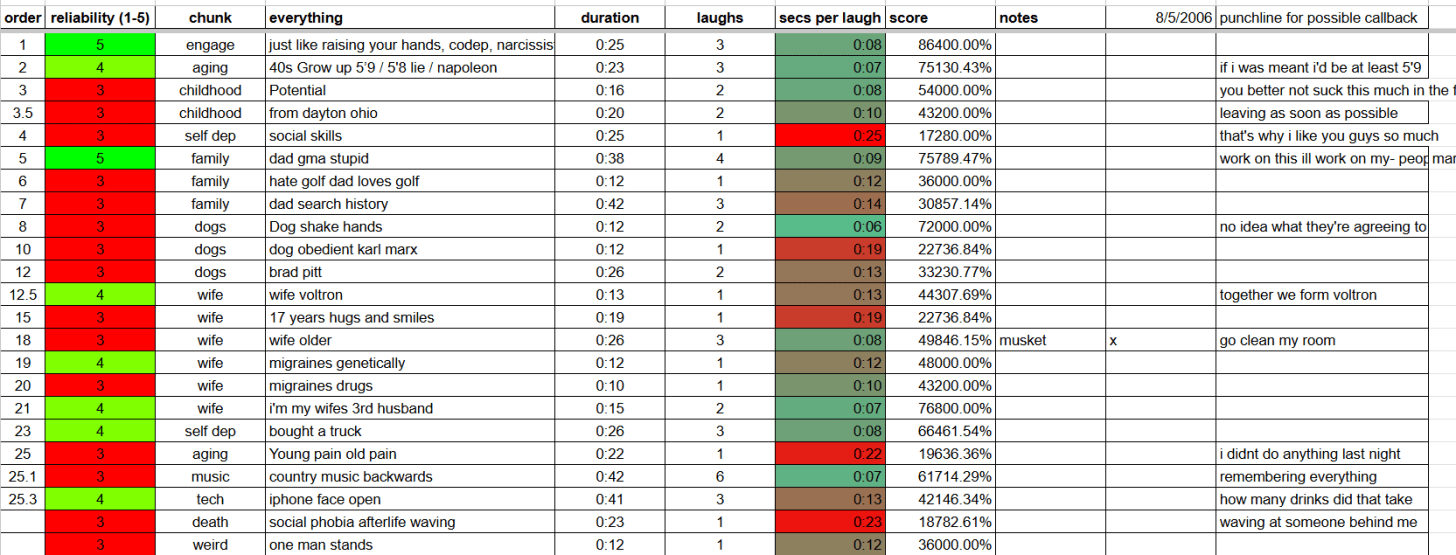
Somebody once said a stand-up comedian is half-autistic, half-some-other-neurodivergence. I haven no idea what they’re talking about.
I used it to optimize joke order — like an ETF manager balancing high-volatility assets against steady dividend payers. Spread out the big laughs. Don’t open too strong or close too flat. Ride momentum, but don’t overexpose.
I was trying to keep audiences engaged.
But what I was really doing was trying to feel validated.
To understand what made people laugh.
To know I wasn’t the only one who thought this way.
Comedy is like stock trading. You risk something personal, and hope for a return.
From Comedy to Self-Care… via AI
Fast forward to the Wyoming event.

I used AI to do superintendant-specific research and to outline the structure based on that and my library of stories, jokes, tips, and tools.
I layered in exercises like:
“Give a compliment to the person next to you”
“List 3 things you’ve done this year to take care of yourself”
It felt light, but it had layers. Because I wasn’t just entertaining them.
I was testing human volatility.
I was watching for signal decay, emotional resistance, social inertia. Like a market cycle — but in khakis and lanyards.
And just like in a portfolio, one table might be done, while another still needs more time.
I walked around like a swing trader — letting some energy ride, and reallocating attention where it was underperforming.
🧠 HEAD CHECKAre you reading your group like a market — or reacting to your own fear of silence?
Have you ever considered that you could run the emotional Sortino ratio of a room, or team, or family?
Minimize downside risk. Maxime return on presence.
Subscribe now
Machine Learning = Personal Growth
All my stock systems — the custom Google Sheets, AI-assisted PineScript, stock and ETF scoring models — they helped me understand something way more human:
You can invest for long-term reasons but freak out about short-term trends.
I used to want high-risk, high-reward returns — in my money and my relationships.
And I got them. Volatile stocks. Volatile girlfriends.
Thrilling highs, followed by emotional faceplants.
Eventually I realized I’m a medium-risk person. I need systems. I need grounded conviction.
So I married someone I could hold.And I built a portfolio I could hold.
Same logic. Same discipline. Same outcome.
Therapy, But With a Punchline
In that workshop, I told jokes about AI reading your shopping habits and accidentally recommending Preparation H out loud while you’re in the store.
I told a story about my dog who feared ceilings because she’d been tied up her whole life.
Then I told the story about my wife almost dying.
And the room got quiet in a new way.
People laughed. Then leaned in. Then got choked up.
They didn’t just want tips. They wanted resonance.
And the funny part?
The best feedback I got wasn’t about the exercises.
It was: “Is your wife okay?”
“Does she know you tell that story?”
Even there, I had to remind people:
Yes. She’s fine. She loves the story. She made me promise to include it.
❤️ HEART CHECKAre you optimizing your performance — or being honest about your needs? It helps to do both!
Share
Investing Is Emotional Engineering
People think investing is about money. It is.
But it’s also about emotion management at scale.
Trading teaches you:
Your perception is flawed.
Fear and greed are terrible advisors.
You need a system that works when you don’t feel like working.
Comedy teaches the same thing.
So does therapy. So does leadership.
And AI? AI just accelerates the feedback loop.
Final Takeaway
Live like a human. Invest like a computer.
That’s what I told a fund manager once, and he nodded like I’d unlocked a secret door.
But really, all I did was use every tool I had — spreadsheets, jokes, AI, therapy, the stock market — to try and become someone worth following.
And then I made keynotes and workshops out of it.
Not perfect. Not normal. Just something real — and really good.
Crazy good.
Thanks for reading Crazy Good: Thinking better. Feeling deeper. Living smarter.! This post is public so feel free to share it.
Share
Crazy Good: Thinking better. Feeling deeper. Living smarter. is a reader-supported publication. To receive new posts and support my work, consider becoming a free or paid subscriber.