I Don’t Like Being Excluded. So I Stopped Excluding Myself.
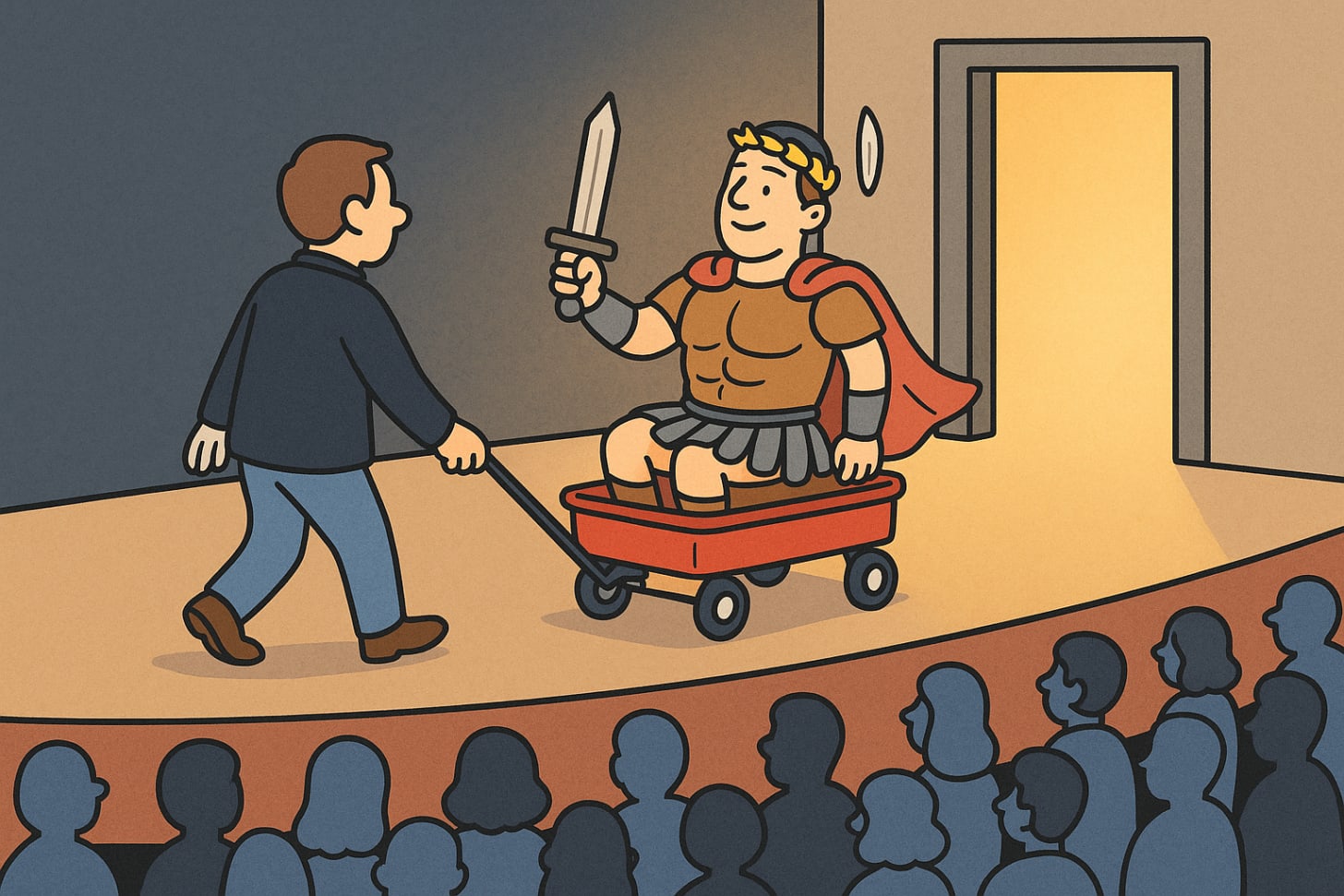
They wheeled me onto stage in a little red wagon wearing a fake muscle suit.
I’m 5’7” playing a Roman gladiator general in front of 200 people. The audience laughed. Perfect.
I’d never been in a play before. Never acted. Never done musical theater. Hell, I didn’t even LIKE musicals until my wife forced me to watch them for 20 years.
Subscribe now
But there I was, singing two solos, dancing (badly), trying to remember where to put my sword while hitting my marks and not falling off the bench.
Why?
Because I don’t like being excluded.
The Guy Who Sang Like A Guitarist
Let me be clear about something: I could not sing.
I mean, I sang like a guitarist—which is to say, terribly. I’d always wanted to be a musician, but singing was not in my skillset. At all.
I also didn’t like musicals. Before I met my wife, I thought musicals were… well, I didn’t think about them. They weren’t for me. I was a stand-up comedian, a geek, a digital ads guy. I liked rock music and playing a little guitar. Musical theater? That was someone else’s world.
And acting? Forget it. I’d never been in a play. Not in elementary school. Not in high school. Not ever.
I was also the guy who, in stand-up comedy, never wanted to do the same joke twice. I liked writing new material. I liked improv. I did NOT like rehearsing the same lines over and over.
So musical theater—with its endless rehearsals, choreography, blocking, and singing the same songs 40 times—was basically my nightmare.
Or so I thought. That was the problem I believed I had: “I can’t do musicals. That’s not for me.”
Simple. Clear. Final.
Twenty Years Of Exclusion (And Slowly Opening Up)
Then I married Lynda.
She’s a professional actor. Been on TV. Done countless community theater roles. Loved by everyone in that world. And she kept dragging me to musicals.
At first? I hated them. Tolerated them at best.
But over time—meeting the actors, the directors, watching her perform, understanding the craft—I started to get it. Musicals are their own world. And if you don’t know any of the major ones, you’re on the outside.
I’ve spent a lot of my life on the outside.
I grew up getting beaten up. Feeling like a victim. Avoiding conflict. Afraid of looking bad. I excluded myself from things because I was scared. Because I thought I couldn’t. Because I thought that world “wasn’t for me.”
But here’s what was really happening underneath all that: I wasn’t being excluded. I was excluding myself. Nobody told me I couldn’t. I just decided I couldn’t.
The wall wasn’t real. I built it.
Somewhere along the way, I made a decision:
F this! I’m not going to exclude myself anymore. I’m going to include myself.
“If they don’t like me, they’ll have to deal with it. I’m participating in life.”
The Weird Path That Got Me There
For some reason—I still don’t fully remember why—I started taking voice lessons.
I found this guy in Charleston who had a really cool philosophy about singing. I thought, Maybe I should learn to actually sing well. Maybe that’ll change things.
We did Zoom lessons after he moved to Chicago. I practiced. My voice got better. Not great. But better.
And here’s the thing: learning to sing helped me speak better. When you learn how to use your breath right, how not to strain your voice, how to project—it all helps when you’re a keynote speaker who doesn’t want to sound like the Def Leppard singer who can’t sing on his own cruise. (What a disappointment that was.)
I also learned something else: after 10 years of keynote speaking, I’d learned the value of rehearsing.
The stand-up guy who never wanted to do the same joke twice? He was gone.
I’d rehearsed my keynotes hundreds of times. Maybe a thousand times across 200 keynotes. And you know what? Doing it over and over didn’t hurt the performance. It made it better. I could explore different things. Find better ways to deliver the joke. Expand it.
So when my wife and her director friend suggested I try out for a musical, I thought:
Maybe I could do that. Maybe I’d want to. It might be an interesting, fun challenge.
That’s the moment everything shifted. When “I can’t do musicals” became “What if I learned how?” One small change in how I saw it—and suddenly a door I thought was a wall opened up.
An ominous… but transformative door! Or is it a window? I have no idea.
Share
How Hard Can It Be?
I got cast in a lead role.
Not a small part. A LEAD. Two solo songs. Choreography. Blocking. Lines. A fake muscle suit and a little red wagon entrance that got huge laughs.
It was terrifying.
I kept forgetting the words. It took me forever to get the lines right, especially when I had to combine them with movements—Where’s my sword? When do I move it? Do I stand on the bench or get down? Who’s carrying me now?
And the dancing? Oh God, the dancing.
I’m not good at dancing. I’m not good at following someone else’s pattern. And the choreography kept changing, which didn’t help. Even up until we were actually performing, I barely had the moves down. I think I screwed it up in at least one performance.
But here’s what I learned—and this is the system that actually works when you’re trying to do something you’ve never done before:
I let people teach me. The voice teacher taught me to sing. The director taught me line readings. The choreographer taught me (badly executed) dance moves.
I took criticism without defending myself. “Try it this way.” Okay. “That’s not quite right.” Got it.
I practiced even when I sucked. Over and over. Forgetting lines. Missing moves. Doing it again.
I tried different approaches. Different line readings. Different timing. Some got laughs. Some didn’t. I learned what worked.
I showed up even when I was bad at it. Right up until performance, I was still screwing up. But I kept showing up.
If you’re willing to be a student—if you’re willing to let people teach you, take criticism, practice, experiment, and keep showing up even when you suck—you can do almost anything.
I don’t know if I’m super talented or if I’ve just been super curious and willing to learn my whole life.
But I pulled it off.
The Award They Gave Me
At the end of the run, they gave everyone funny awards.
Mine was the “How Hard Can It Be?” Award.
Guy who’s never done a play or musical. Let’s put him in the lead role with two solo songs. How hard can it be?
Pretty hard, actually.
But I did it.
And you know what? I’m thinking about doing another one. More dancing that I’m not good at. More lines to remember.
Because I had some very good moments. My voice sounded good. There were moments I was proud of. And that’s how you know it worked—when the thing that used to terrify you now sounds like fun.
But mostly? I’m proud of myself for going through the process.
For not excluding myself.
The Real Lesson (It’s Not About Musicals)
Here’s the pattern I’ve seen over and over in my life:
You think you have a problem. “I can’t sing. I can’t do musicals. That’s not for me.”
But the real problem is underneath. You’re excluding yourself. Not because you can’t—because you’re afraid. Because you’ve decided you can’t.
Then one moment changes how you see it. “What if ‘I can’t’ just means ‘I haven’t learned yet’?”
So you build a system to learn it. Find teachers. Practice. Take criticism. Try different approaches. Show up even when you suck.
And then you know it worked. Not because you’re perfect—because you’re willing to try again.
That’s how it worked with musicals. That’s how it worked with keynote speaking. That’s how it works with everything.
“I can’t” usually just means “I haven’t learned yet.”
I couldn’t sing. Then I took lessons. Now I can.I couldn’t act. Then I let people teach me. Now I can.I couldn’t dance. Well… I still can’t. But I can do it badly enough to get through a show.
The question isn’t “Am I talented enough?”The question is: “Am I willing to be a student?”
What Are You Excluding Yourself From?
I’ve always wanted to be able to talk to anybody. Hang out with anybody. Have good conversations with anyone. Be part of life.
Every time I try something new—stand-up comedy, keynote speaking, musicals—I open up to more of life. More conversations. More people. More experiences.
I don’t like being excluded. I never did.
So I stopped excluding myself.
Now ask yourself: What are you excluding yourself from?
Not because you can’t.
Because you think you can’t.
What’s the thing you’ve decided “isn’t for you”? The career. The relationship. The creative pursuit. The leadership role. The bold move.
Look again.
What if you’re just one lesson away? One teacher, one mentor, one person willing to show you the way?
What if “I can’t” is really “I haven’t learned yet”?
And what if the only thing stopping you… is you?
I Was That Guy
I excluded myself for years. Stayed on the outside. Was afraid. Played small.
Then I decided: eff this. I’m participating.
I took voice lessons. I let people teach me. I got in the little red wagon.
And now? I help other people stop excluding themselves.
That’s what I do. I see where you’re standing outside your own life. Where you’ve decided “that’s not for me” when really it’s “I haven’t learned how yet.”
I was Garrison’s student when he showed me I could be a keynote speaker.I’m still a student every time I step on a stage—musical or otherwise.
And I help my clients become students again—curious, willing, open to being taught.
Because the thing you think you can’t do? Look again.
You might just need someone to wheel you out in a red wagon and show you it’s possible.
Brian CarterKeynote Speaker | Red-Pill Coach | Morpheus to your Neo, maybe, but not as cool as Laurence FishburneHelping leaders see what they’re missing so they can solve problems once, not ten times | Guy who uses too many taglines | Hope you liked this article!