Inside a $2B Company's AI Marketing Transformation: What You Can Learn
Last week, I received an email that would lead me down one of the most complex research rabbit holes of my speaking career.
The subject line was a simple contact form submission, but what unfolded was a masterclass in how modern enterprises are wrestling with AI adoption—and how the right strategic approach can transform marketing teams from overwhelmed order-takers into sophisticated revenue engines.
The client was a multi-billion-dollar enterprise consultancy formed through the acquisition of a number of companies over the last few years. Their challenge wasn’t unique, but their approach to solving it was remarkably thoughtful: they wanted to use AI to position themselves as strategic advisors rather than commodity integrators, competing with major consulting firms instead of being lumped in with traditional IT service providers.
What I discovered during my research process reveals critical insights that any B2B company can apply—whether you’re a 10-person consultancy or a Fortune 500 enterprise. The patterns, tools, and strategies that emerged from this engagement offer a roadmap for leveraging AI to multiply marketing impact without multiplying headcount.
The Assignment: Strategic Positioning Through AI Sophistication
The initial request seemed straightforward: deliver a 45-minute keynote on AI applications for B2B marketing to the company’s 35-person marketing team. But as I dug deeper through questionnaires and stakeholder conversations, a more complex picture emerged.
The marketing leader described their core challenge during our customization call: “We’re struggling with positioning around IT services and AI—combining the strategy of a consultant with the tech savvy and tools of an integrator.” The CEO believed they competed with major consulting firms like Deloitte and Accenture, while the market still saw them as another traditional IT integrator.
This positioning challenge created a fascinating opportunity: use AI marketing sophistication as a demonstration of strategic capability. When enterprise clients see a consulting firm deploying advanced AI for their own marketing operations, it builds immediate credibility for their AI transformation recommendations. Conversely, when prospects see basic automation and generic content strategies, it signals “commodity provider” regardless of technical capabilities.
The company’s marketing team was distributed across four key functions:
Content Marketing: Thought leadership, white papers, case studies, SEO
Digital Marketing & Operations: Campaign management, marketing automation, data analysis
Creative & Design: Brand assets, presentations, visual content
Events & Partnerships: Trade shows, co-marketing with 200+ technology vendors
Field Marketing: Regional sales support and account-based marketing
Each team faced distinct challenges, but they shared common pain points: bandwidth constraints, competing priorities, and data scattered across multiple platforms from various acquisitions. Their current tech stack included HubSpot, Salesforce, PowerBI, ZoomInfo, and several other tools that weren’t properly integrated.
Most tellingly, when asked how unified their customer and prospect data was across platforms, the response was blunt: “It’s a mess.”
That’s incredibly common, I find. We have more data than ideas for how to use it.
Data may not be sexy, but the impact from your data’s insights is!
The Research Deep Dive: Mapping the AI Marketing Landscape
With budget season approaching (their 2026 planning was “heavily influenced by what we can achieve with AI”), I needed to provide specific tool recommendations with clear ROI projections.
And I had just six days to prepare!
This required extensive research into three distinct areas:
Current AI Tool Capabilities
I analyzed dozens of AI marketing platforms, from affordable options like ChatGPT Plus ($20/month) to enterprise solutions like Demandbase (custom pricing starting around $50K annually). The key was understanding not just what each tool could do, but how they’d integrate with the company’s existing systems and address their specific positioning challenge.
Competitive Intelligence
The research revealed a clear pattern:
Companies positioning themselves as strategic advisors invest 3-5x more in sophisticated AI marketing tools than those competing on price.
Crazy Good is a reader-supported publication. To receive new pots and support my work, consider becoming a free or paid subscriber.
Elite consulting firms deploy enterprise-grade platforms like Salesforce Marketing Cloud Einstein and Adobe Experience Manager, while traditional integrators often rely on basic automation.
This created a “walk the talk” opportunity—demonstrating AI sophistication internally validates external AI consulting recommendations.
Industry Case Studies
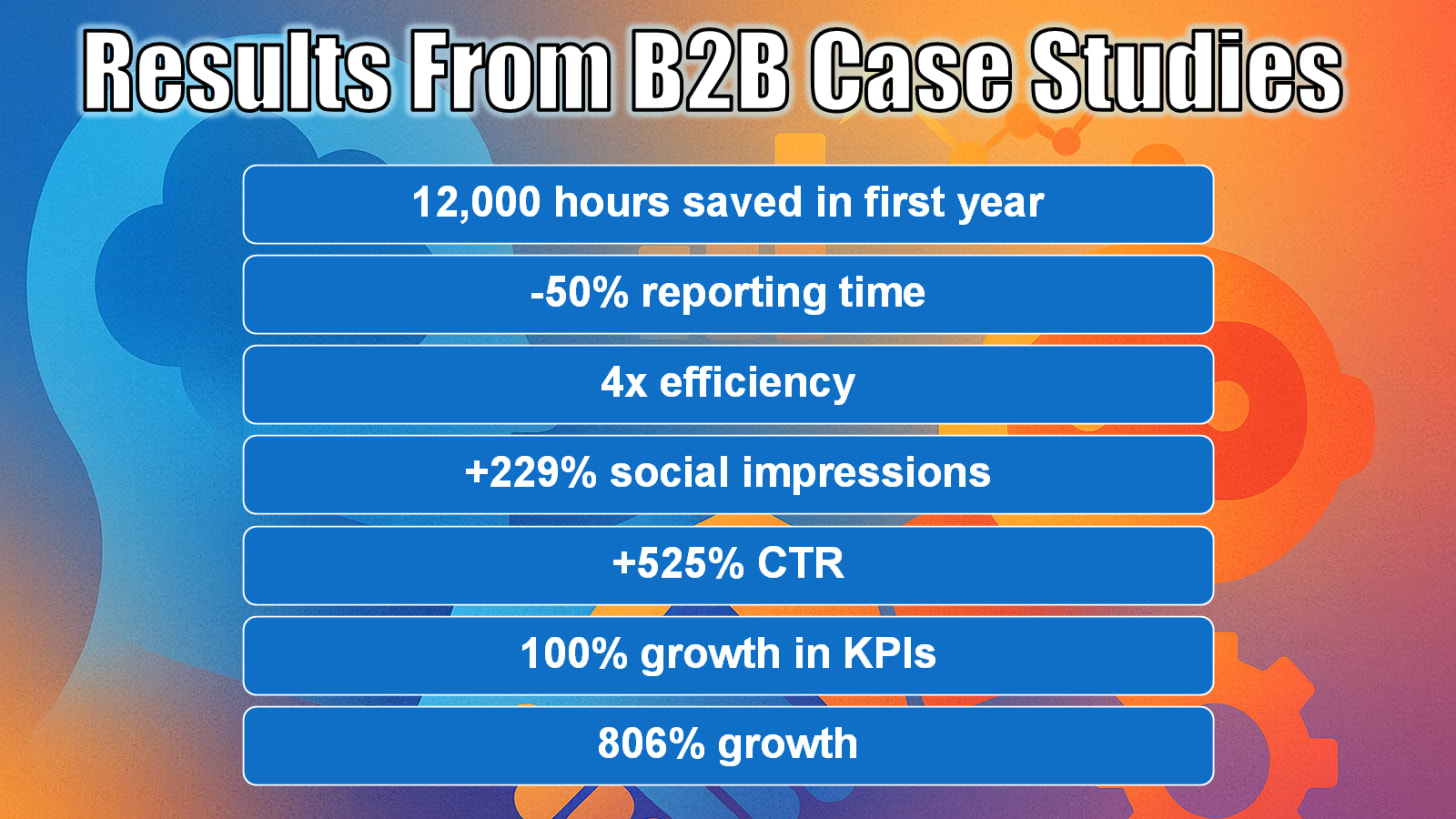
I compiled over a dozen case studies showing measurable results from AI marketing implementations:
A consulting agency achieving 100% growth in KPIs using marketing automation
Professional services firms seeing 4x efficiency improvements
B2B companies generating $1,000 per 1,000 emails through AI-powered segmentation
Social media automation saving 12,000 hours annually
The Discovery: Five Critical AI Marketing Foundations
Through analysis of successful implementations and the company’s specific needs, five essential areas emerged where AI could transform their marketing operations:
1. Data Integration Foundation: From Chaos to Unity
The “data mess” problem wasn’t unique—it’s endemic among companies formed through acquisitions. But AI offers unprecedented solutions for unifying disparate systems.
Instead of expensive enterprise data integration projects, modern AI tools can connect existing platforms automatically. Zapier Professional ($30/month) can sync data between HubSpot and Salesforce in real-time. Improvado ($2,000+/month) creates unified marketing dashboards pulling from all platforms simultaneously. ThoughtSpot enables natural language queries like “Which campaigns drove the most healthcare pipeline?” across all connected data.
The key insight: AI doesn’t require ripping and replacing existing systems—it makes them work together intelligently.
2. Content Team Amplification: From Overwhelmed to Multiplied
The content team was already using ChatGPT for basic writing assistance, but they were barely scratching the surface of AI’s content multiplication capabilities.
Advanced implementation enables transforming one white paper into 24 different marketing assets: blog posts, social media campaigns, email sequences, presentation slides, and industry-specific adaptations for healthcare, finance, and energy sectors. Tools like Jasper Enterprise ($100+/month) can maintain consistent brand voice across all formats, while Writer.com ($30+/month) ensures compliance requirements for regulated industries.
The strategic advantage: AI enables thought leadership production at consulting firm scale without consulting firm budgets.
3. Creative Efficiency Without Replacement
The design team showed the most resistance to AI adoption, concerned about job security and creative authenticity. This required careful positioning of AI as enhancement rather than replacement.
Modern AI design tools don’t replace creative decision-making—they eliminate tedious manual work. Canva Pro ($15/month) can resize one design into 30+ formats automatically. Adobe Firefly (included with Creative Cloud) generates custom backgrounds and visual elements while maintaining brand consistency. Brandfolder uses AI to check brand compliance automatically and organize assets intelligently.
The psychological shift: AI handles the repetitive tasks so designers can focus on strategy and creative concepts.
4. Advanced ABM and Intelligence: From Reactive to Predictive
Account-based marketing traditionally required extensive manual research and generic outreach. AI transforms this into predictive, personalized engagement at scale.
6sense (enterprise pricing) identifies which Fortune 500 companies are researching solutions before RFPs are issued. Apollo.io ($49/month) provides AI-powered prospect research creating personalized outreach based on recent company news, executive changes, and industry developments. ActiveDEMAND enables multi-touch attribution showing exactly which marketing activities drive revenue.
The competitive advantage: AI-powered ABM enables smaller teams to compete with the relationship-building capabilities of much larger firms.
5. Budget Strategy: From Uncertain to Strategic
The 2026 budget planning presented an opportunity to frame AI investments strategically rather than as additional overhead.
The research revealed that most AI marketing tools cost less than hiring one additional team member. ChatGPT Team ($25/user/month) provides organization-wide capabilities for less than a single day’s salary for most marketing professionals. HubSpot AI upgrades often include features already paid for but not activated. Zapier Professional ($30/month) can replace many manual processes immediately.
The business case: AI tools multiply existing team capabilities rather than requiring additional headcount.
Thanks for reading! This post is public so feel free to share it.
Share
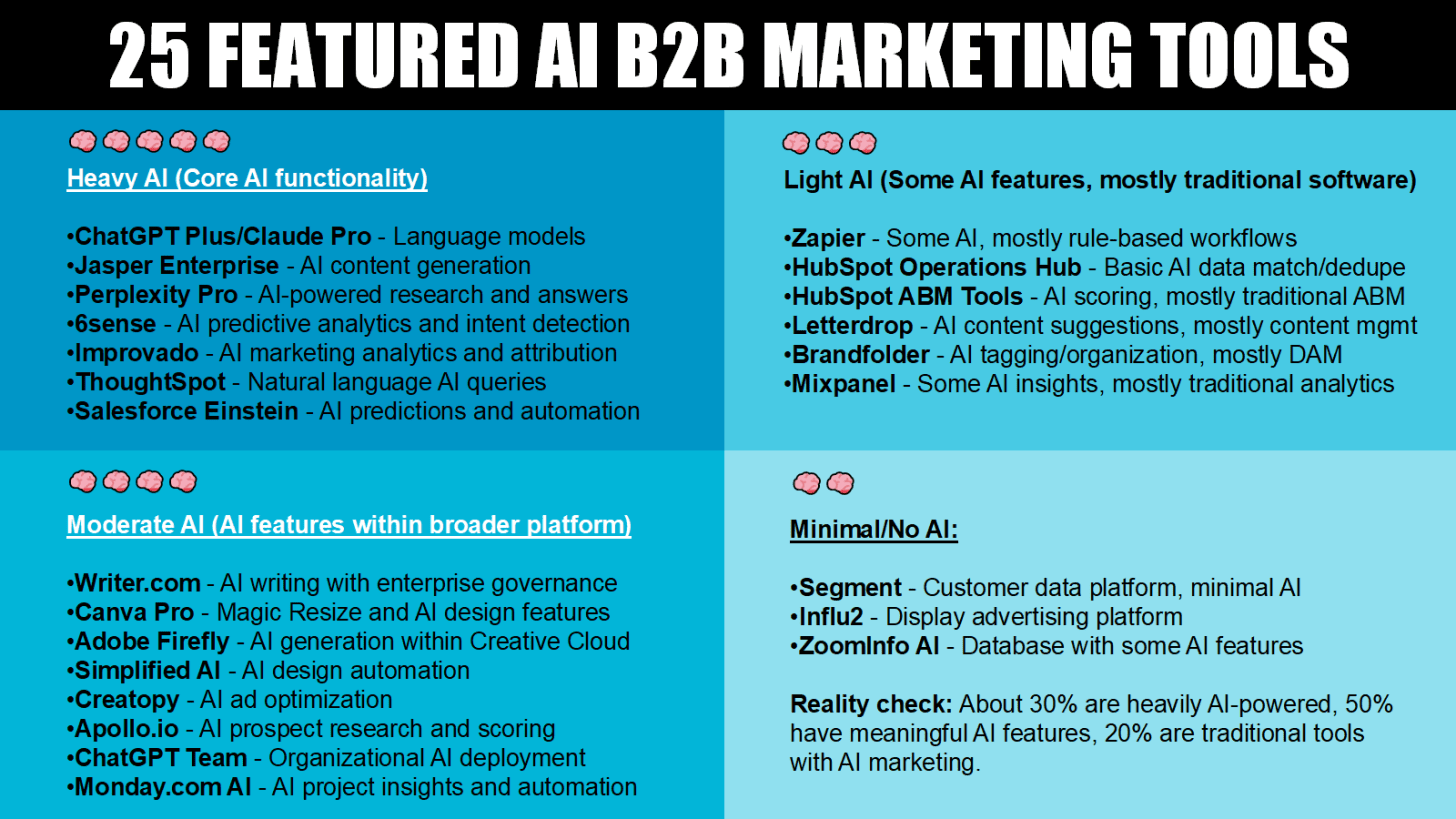
The Tool Stack: 25 Strategic Recommendations
After analyzing hundreds of potential solutions, I narrowed recommendations to 27 tools across the five foundation areas. The key was avoiding redundancy while ensuring each recommendation addressed genuine capability gaps rather than duplicating existing functionality.
High-Impact, Low-Cost Options:
ChatGPT Plus/Claude Pro ($20/month): Advanced content creation and data analysis
Canva Pro ($15/month): AI design automation and asset resizing
Perplexity Pro ($20/month): Real-time research and competitive intelligence
Zapier Professional ($30/month): Automation across all existing platforms
Mid-Tier Strategic Additions:
Apollo.io ($49/month): AI-powered prospect research and outreach
Jasper Enterprise ($100+/month): Brand-trained content AI with governance
Writer.com ($30+/month): Enterprise content platform with compliance features
Enterprise-Grade Investments:
6sense (custom pricing): Predictive account intelligence and intent data
Improvado ($2,000+/month): Marketing data unification with AI analytics
Salesforce Einstein ($75+/month): AI enhancements to existing CRM investment
The total recommended investment ranged from $500/month (basic stack) to $15,000+/month (enterprise implementation)—representing sophisticated marketing operations for far less than traditional enterprise solutions.
Platform-Specific Use Cases: 75 Ways to Deploy AI
Understanding that different AI platforms excel at different tasks, I developed 75 specific use cases distributed across ChatGPT, Claude, and Perplexity:
ChatGPT excels at: Content creation, data analysis, automation scripts, visual generation
Upload prospect engagement data and build predictive models showing conversion likelihood
Use DALL-E to generate custom presentation graphics aligned with brand aesthetics
Create automated workflows that trigger personalized outreach based on behavior
Claude specializes in: Strategic analysis, long-form content, complex document processing
Analyze entire tech stack documentation to create unified data governance policies
Process multiple client interview transcripts to extract authoritative thought leadership themes
Create comprehensive account intelligence reports from detailed prospect information
Perplexity dominates: Real-time research, competitive intelligence, current market data
Research target accounts for recent news, executive changes, and business opportunities
Find current pricing and feature comparisons for marketing tools and platforms
Monitor industry trends and regulatory changes affecting target client segments
Implementation Strategy: The 90-Day Transformation
Rather than overwhelming the team with 27 new tools simultaneously, I recommended a phased approach:
Month 1: Foundation
Deploy core AI platforms (ChatGPT, Claude, Perplexity) across all teams
Implement basic data connections (Zapier) between existing systems
Begin content multiplication using AI tools
Start automated prospect research workflows
Month 2: Amplification
Add specialized tools for each team’s primary pain points
Implement advanced email automation and segmentation
Deploy AI-powered creative asset management
Launch predictive lead scoring and account intelligence
Month 3: Optimization
Integrate advanced analytics and attribution modeling
Implement enterprise-grade AI content and design tools
Launch comprehensive ABM campaigns using AI intelligence
Deploy automated competitive monitoring and market research
The phased approach ensures adoption success while building internal momentum and demonstrating ROI at each stage.
The Keynote Structure: Ideas That Spark Action
The 45-minute presentation followed a carefully crafted structure designed to generate “Did you know this was possible?” moments while providing immediately actionable insights:
Opening: The Positioning Challenge (5 minutes)
Framed AI sophistication as competitive differentiation, not just efficiency improvement. When enterprise clients evaluate potential partners, they assess AI capabilities as an indicator of strategic thinking and operational excellence.
Five Core Sections (30 minutes total):
Data Integration (6 minutes): “Scattered → Connected”
Content Amplification (6 minutes): “Overwhelmed → Multiplied”
Creative Efficiency (6 minutes): “Tedious → Streamlined”
ABM Intelligence (6 minutes): “Reactive → Predictive”
Budget Strategy (6 minutes): “Uncertain → Strategic”
Each section included specific “misconception vs. reality” examples and tool demonstrations showing capabilities the team hadn’t considered.
Interactive Elements (10 minutes distributed):
Rather than traditional Q&A, I embedded interactive moments throughout each section, encouraging teams to identify applications for their specific challenges and add ideas to their afternoon presentations.
The format ensured 50% takeaways, 30% motivation, and 20% entertainment—exactly the mix requested by leadership.
Universal Lessons: AI Marketing Principles Any Company Can Apply
While this engagement focused on a specific enterprise client, the research revealed universal principles that any B2B company can leverage:
Principle 1: Start with Integration, Not Addition
The biggest mistake companies make is adding AI tools on top of existing inefficiencies. Begin by using AI to connect and optimize current systems before introducing new platforms.
Practical Application: Before buying new tools, use ChatGPT to analyze your current tech stack and identify integration opportunities. Most companies discover they’re using less than 50% of their existing platform capabilities.
Principle 2: Match AI Tools to Team Psychology
Technical capabilities matter less than adoption willingness. The most sophisticated AI tool fails if teams won’t use it consistently.
Implementation Strategy: Start with teams showing AI enthusiasm (often content or digital marketing), achieve quick wins, then expand to more cautious groups with proven success stories.
Principle 3: Frame AI as Capability Multiplication
Position AI tools as making teams more strategic rather than replacing human judgment. This reduces resistance while encouraging exploration.
Messaging Framework: “AI handles the repetitive work so you can focus on strategy and relationships”—this resonates across functions from creative to sales.
Principle 4: Measure ROI in Time Saved, Not Just Revenue Generated
While revenue impact takes months to measure, time savings are immediately visible and build internal support for expanded AI adoption.
Metrics That Matter:
Hours saved per week on manual tasks
Reduction in content creation time
Increase in personalized outreach capacity
Improvement in data analysis frequency
Principle 5: Use AI Sophistication as Competitive Positioning
For B2B companies, AI marketing capabilities become sales tools. Prospects evaluate your AI sophistication as an indicator of your ability to help them with their own transformation.
Strategic Advantage: Companies demonstrating advanced AI in their own operations gain credibility when proposing AI solutions for clients.
Tool Categories: Building Your AI Marketing Stack
Based on extensive research and client implementations, AI marketing tools fall into five essential categories. Here’s how any company can evaluate and implement solutions in each area:
Data Intelligence Tools
Essential for: Companies with multiple platforms, complex attribution needs, or scattered customer data
Starter Options:
Zapier ($20-30/month): Connect existing platforms automatically
Google Analytics 4 (free): AI-powered insights and predictions
HubSpot AI features (often included): Smart lead scoring and content optimization
Advanced Options:
Improvado ($2,000+/month): Unified marketing data warehouse
ThoughtSpot (enterprise pricing): Natural language data queries
Mixpanel ($20-400+/month): Behavioral analytics and predictive modeling
ROI Indicators: Look for 30-50% reduction in reporting time and 15-25% improvement in campaign attribution accuracy.
Content Intelligence Tools
Essential for: Teams creating regular thought leadership, multiple content formats, or industry-specific materials
Starter Options:
ChatGPT Plus ($20/month): Content creation, repurposing, and optimization
Grammarly Business ($15/user/month): AI writing assistance and brand consistency
Canva Pro ($15/month): AI design creation and brand template management
Advanced Options:
Jasper Enterprise ($100+/user/month): Brand-trained AI with governance features
Writer.com ($30+/user/month): Enterprise content platform with compliance
Surfer SEO ($89+/month): AI-powered content optimization and competitive analysis
ROI Indicators: Teams should see 40-60% reduction in content creation time and ability to produce 3-5x more content variations.
Creative Intelligence Tools
Essential for: Companies creating regular visual content, managing brand consistency, or supporting multiple product lines
Starter Options:
Canva Magic Design ($15/month): AI layout generation and automatic resizing
ChatGPT with DALL-E ($20/month): Custom graphic creation and visual concepts
Adobe Firefly (included with Creative Cloud): AI image generation within professional tools
Advanced Options:
Simplified AI ($20/month): Batch processing and automated creative variations
Brandfolder (custom pricing): AI-powered brand compliance and asset management
Creatopy ($49+/month): Advanced ad automation and performance optimization
ROI Indicators: Look for 50-70% reduction in design production time and ability to create 5-10x more creative variations per campaign.
Intelligence and Automation Tools
Essential for: Companies with complex sales cycles, multiple touchpoints, or account-based marketing strategies
Starter Options:
Apollo.io ($49/month): AI prospect research and outreach automation
HubSpot Workflows (included in most plans): Behavioral automation and lead nurturing
LinkedIn Sales Navigator ($80/month): AI-powered prospecting and relationship mapping
Advanced Options:
6sense (enterprise pricing): Predictive account intelligence and intent data
Demandbase (custom pricing): Comprehensive ABM platform with AI orchestration
Outreach.io ($100+/user/month): AI-powered sales engagement and optimization
ROI Indicators: Expect 25-40% improvement in lead qualification accuracy and 15-30% increase in campaign conversion rates.
Analytics and Optimization Tools
Essential for: Companies needing advanced performance measurement, predictive insights, or automated optimization
Starter Options:
Google Analytics 4 with AI features (free): Predictive metrics and automated insights
HubSpot Analytics (included): AI-powered performance optimization and recommendations
Mailchimp AI features ($20+/month): Automated email optimization and send time prediction
Advanced Options:
Salesforce Einstein Analytics ($75+/user/month): Comprehensive CRM AI with predictive modeling
VWO ($227+/month): AI-powered experimentation and conversion optimization
Optimizely (custom pricing): Advanced testing and personalization platform
ROI Indicators: Look for 20-35% improvement in campaign performance and ability to run 3-5x more optimization tests.
Implementation Roadmap: Your 90-Day AI Transformation
Here’s a proven framework any B2B company can follow to implement AI marketing capabilities systematically:
Pre-Implementation (Week -2 to 0)
Audit Current State:
Inventory existing marketing tools and integration points
Identify top 3 time-consuming manual processes per team
Document current performance baselines for comparison
Survey team AI experience and enthusiasm levels
Set Success Metrics:
Time savings targets (hours per week)
Quality improvement goals (content output, lead scores)
Revenue impact projections (6-month horizon)
Team adoption milestones (percentage of staff actively using tools)
Month 1: Foundation Building
Week 1-2: Core Platform Deployment
Set up ChatGPT Plus/Claude Pro for all team members
Implement basic Zapier connections between existing tools
Create shared prompt libraries for common tasks
Begin content multiplication experiments
Week 3-4: Quick Wins
Deploy AI writing assistance for all content creation
Implement automated lead research workflows
Start AI-powered email personalization
Launch basic design automation for social media
Month 1 Success Indicators:
80% of team actively using core AI platforms
20% reduction in content creation time
5+ automated workflows connecting existing systems
Month 2: Capability Expansion
Week 5-6: Team-Specific Tools
Add specialized tools for each team’s primary challenges
Implement advanced segmentation and automation
Deploy AI-powered competitive intelligence
Launch predictive lead scoring
Week 7-8: Integration and Optimization
Connect new tools to existing workflows
Optimize AI prompts and automation rules
Train teams on advanced platform features
Begin measuring ROI and performance improvements
Month 2 Success Indicators:
40% reduction in manual reporting tasks
3x increase in personalized outreach capacity
25% improvement in lead qualification accuracy
Month 3: Advanced Implementation
Week 9-10: Enterprise-Grade Features
Deploy comprehensive analytics and attribution
Implement advanced ABM and account intelligence
Launch automated competitive monitoring
Integrate AI insights into strategic planning
Week 11-12: Optimization and Scale
Fine-tune all AI tools for maximum performance
Create advanced automation sequences
Implement predictive analytics for forecasting
Document processes and train additional team members
Month 3 Success Indicators:
60% overall improvement in marketing efficiency
35% increase in qualified lead generation
50% reduction in time from lead to opportunity
Months 4-6: Mastery and Innovation
Continuous Improvement:
Regular performance reviews and optimization
Experimentation with cutting-edge AI tools
Integration of AI insights into business strategy
Knowledge sharing across departments
Measuring Success: KPIs That Matter
Successful AI marketing implementation requires tracking both efficiency and effectiveness metrics:
Efficiency Metrics (Immediate Impact)
Time Savings: Hours saved per week on manual tasks
Content Output: Increase in content pieces produced per month
Campaign Deployment: Reduction in time from concept to launch
Data Analysis: Frequency of insights generation and reporting
Effectiveness Metrics (3-6 Month Impact)
Lead Quality: Improvement in lead-to-opportunity conversion rates
Campaign Performance: Increase in email open rates, click-through rates, and engagement
Sales Alignment: Improvement in marketing qualified lead acceptance rates
Revenue Attribution: Better tracking of marketing’s impact on pipeline and revenue
Strategic Metrics (6-12 Month Impact)
Competitive Positioning: Win rates against key competitors
Market Presence: Share of voice in industry conversations
Client Perception: Feedback on marketing sophistication and thought leadership
Revenue Growth: Direct correlation between AI marketing investments and business growth
Common Pitfalls and How to Avoid Them
Through client implementations and industry research, several patterns of failure emerge consistently:
Pitfall 1: Tool Proliferation Without Integration
The Problem: Companies add AI tools without connecting them to existing workflows, creating more complexity instead of simplification.
The Solution: Always start with integration before addition. Use AI to optimize current processes before introducing new platforms.
Pitfall 2: Ignoring Change Management
The Problem: Focusing on technical capabilities while ignoring team psychology and adoption challenges.
The Solution: Invest equal time in training, communication, and success celebration as in tool implementation.
Pitfall 3: Expecting Immediate ROI
The Problem: Demanding revenue impact within 30 days when AI marketing benefits compound over time.
The Solution: Track efficiency gains first, effectiveness improvements second, and revenue impact third over a 3-6 month timeline.
Pitfall 4: One-Size-Fits-All Implementation
The Problem: Deploying identical AI solutions across teams with different needs, skills, and challenges.
The Solution: Customize AI tool selection and implementation approach for each team while maintaining overall strategic coherence.
The Future of AI Marketing: What’s Coming Next
Based on current development trends and enterprise adoption patterns, several significant advances will reshape AI marketing over the next 12-24 months:
Autonomous Marketing Agents
AI systems will evolve from tools requiring human direction to autonomous agents capable of planning and executing complete marketing campaigns. Early implementations already show AI agents managing multi-step workflows from prospect identification through conversion.
Real-Time Personalization at Scale
AI will enable personalization beyond demographic segments to individual behavioral patterns, creating unique experiences for each prospect based on their specific engagement history and preferences.
Predictive Content Creation
Instead of reacting to market trends, AI will predict content needs and create materials before demand peaks, giving early adopters significant competitive advantages.
Cross-Platform Intelligence
AI will unify insights across all marketing platforms, social networks, and external data sources to create comprehensive views of market opportunities and competitive positioning.
Your Next Steps: Implementing AI Marketing Today
The research and implementation process for this enterprise client reveals a clear pathway for any B2B company ready to leverage AI for marketing advantage:
Immediate Actions (This Week)
Audit your current marketing tech stack and identify integration opportunities
Sign up for ChatGPT Plus and Claude Pro to begin experimenting with AI content creation
Document your top 5 most time-consuming manual marketing processes for potential automation
Survey your team’s AI experience and enthusiasm to identify early adopters and potential resistance
30-Day Implementation Plan
Deploy core AI platforms across content and digital marketing teams
Implement basic automations connecting your existing CRM and marketing platforms
Create shared prompt libraries for common content creation and research tasks
Establish success metrics for time savings and quality improvements
Strategic Considerations
Budget allocation: Most companies see positive ROI within 90 days with monthly investments starting around $500-1,000
Team training: Plan for 2-4 hours of initial training per team member plus ongoing skill development
Change management: Expect 6-12 weeks for full adoption across teams with varying technology comfort levels
Competitive advantage: Companies implementing AI marketing systematically gain 12-18 months advantage over those taking ad-hoc approaches
Conclusion: The Strategic Imperative
The enterprise client engagement revealed a fundamental truth about modern B2B marketing: AI sophistication has become a competitive differentiator, not just an efficiency tool. Companies that deploy advanced AI marketing capabilities demonstrate strategic thinking and operational excellence that resonates with sophisticated buyers.
For the multi-billion-dollar consultancy, implementing AI marketing tools wasn’t just about saving time or reducing costs—it was about positioning themselves as the kind of innovative, strategic partner that Fortune 500 clients want to work with. When prospects see a company using cutting-edge AI for their own marketing operations, it validates their capability to implement similar transformations for clients.
This dynamic extends beyond large enterprises. Any B2B company can use AI marketing sophistication to punch above their weight class, competing with larger firms by demonstrating superior efficiency, personalization, and strategic thinking.
The tools exist, the playbooks are proven, and the competitive advantage is available to companies ready to implement systematically. The question isn’t whether AI will transform B2B marketing—it’s whether your company will lead that transformation or be left behind by competitors who move first.
The 45-minute keynote delivered specific tactics and tools, but the larger strategic insight remains: in an increasingly competitive B2B landscape, AI marketing capabilities separate strategic partners from commodity providers. Companies that understand and act on this insight will define the next decade of business services and consulting.
Whether you’re leading marketing for a 50-person agency or a Fortune 500 enterprise, the same principles apply: start with integration, focus on capability multiplication, measure efficiency gains first, and use AI sophistication as competitive positioning. The tools and strategies are available—the only question is how quickly you’ll implement them.
Brian Carter helps companies leverage AI for competitive advantage through keynotes, workshops, and strategic consulting. His 25+ years of marketing experience combined with deep AI expertise enables organizations to implement practical AI solutions that drive measurable results. For speaking inquiries or AI marketing strategy consulting, visit keynotespeakerbrian.com
Leave a comment