Prosus (PROSY): Stock Analysis On Why Technology’s Best-Kept Momentum Secret Is Breaking Out
Hey guys, to be transparent, this is a research brief mostly from AI research, not one of my typical breezy, goofy articles.
But I thought since I was researching it, you might find it interesting!
Subscribe now
DISCLAIMER: I am not a financial planner or certified financial anything.I am more certifiable than certified. None of this is investment advice. Please consult a financial expert or planner before making trading decisions,and be vewy, vewy careful.
Prosus (PROSY): A Global Tech Investment Play Riding Momentum
Prosus N.V. has surged onto the radar of global momentum traders in 2025. As one of the world’s largest and most diverse technology investors, Prosus’s shares have climbed nearly 70% over the past year, with a more than 40% gain year-to-date. This upward momentum is attracting traders who gravitate to stocks exhibiting both strong technical tailwinds and compelling stories.

What Is Prosus?
Based in the Netherlands and a spinoff from South Africa’s Naspers, Prosus holds a massive, diversified global portfolio of technology assets. It is best known for its stake in Tencent, but its reach spreads through sectors like e-commerce, digital payments, food delivery, classifieds, and edtech.
The company’s portfolio includes stakes in giants like Tencent, OLX, PayU, iFood, Delivery Hero, Swiggy, Stack Overflow, Udemy, Ctrip, and dozens of other growth-stage firms across all continents.
Why Is Prosus Rallying?
Profitability Surprise: After years of only headline-grabbing investments, Prosus has delivered aggregate e-commerce profitability, swinging from significant losses to $110 million in operating profit in just a year. The company’s revenue hit $6.17 billion in 2025, up nearly 13% over the prior year, further boosting bullish sentiment.
Aggressive Buybacks: Management has funded robust share repurchases by selling down part of its Tencent stake, shrinking shares outstanding and closing the persistent “NAV discount” that haunted Prosus’s valuation for years.
Diversified Growth Engines: Prosus’s exposure to high-growth emerging markets like India and Brazil in sectors such as food delivery, fintech, and digital classifieds gives it leverage to major secular trends outside the U.S. and China.
Transformation into a ‘Platform Company’: Prosus is rapidly integrating AI and automation across its portfolio, mirroring the playbook of other successful global tech conglomerates.
Competitive Context
Prosus arguably has no true direct rival with the same global tech-investment focus, but the closest competitors in approach and scale are:
SoftBank Group (TSE: 9984)
Naspers (JSE: NPN, OTC: NPSNY)
Tencent (HKEX: 0700, OTC: TCEHY)
Alibaba Group (NYSE: BABA, HKEX: 9988)
Baidu (NASDAQ: BIDU, HKEX: 9888)
Meta (NASDAQ: META)
Alphabet (NASDAQ: GOOGL)
Prosus’s holdings place it at the competitive crossroads of several high-growth industries.
In digital payments and fintech, major U.S.-listed competitors include PayPal (PYPL), Block (SQ), Fiserv (FISV), MercadoLibre (MELI), StoneCo (STNE), PagSeguro (PAGS), and Nubank (NU).
In food delivery and online mobility, Prosus faces DoorDash (DASH) and Uber Technologies (UBER), each controlling significant market share in North America.
E-commerce and classifieds competition comes from Amazon (AMZN), eBay (EBAY), JD.com (JD), Sea Limited (SE), and MercadoLibre (MELI).
For online education, Prosus’s investments compete against Duolingo (DUOL), Chegg (CHGG), Udemy (UDMY), and Coursera (COUR).
The online travel segment features platforms such as Trip.com (TCOM), Booking Holdings (BKNG), and Expedia Group (EXPE).
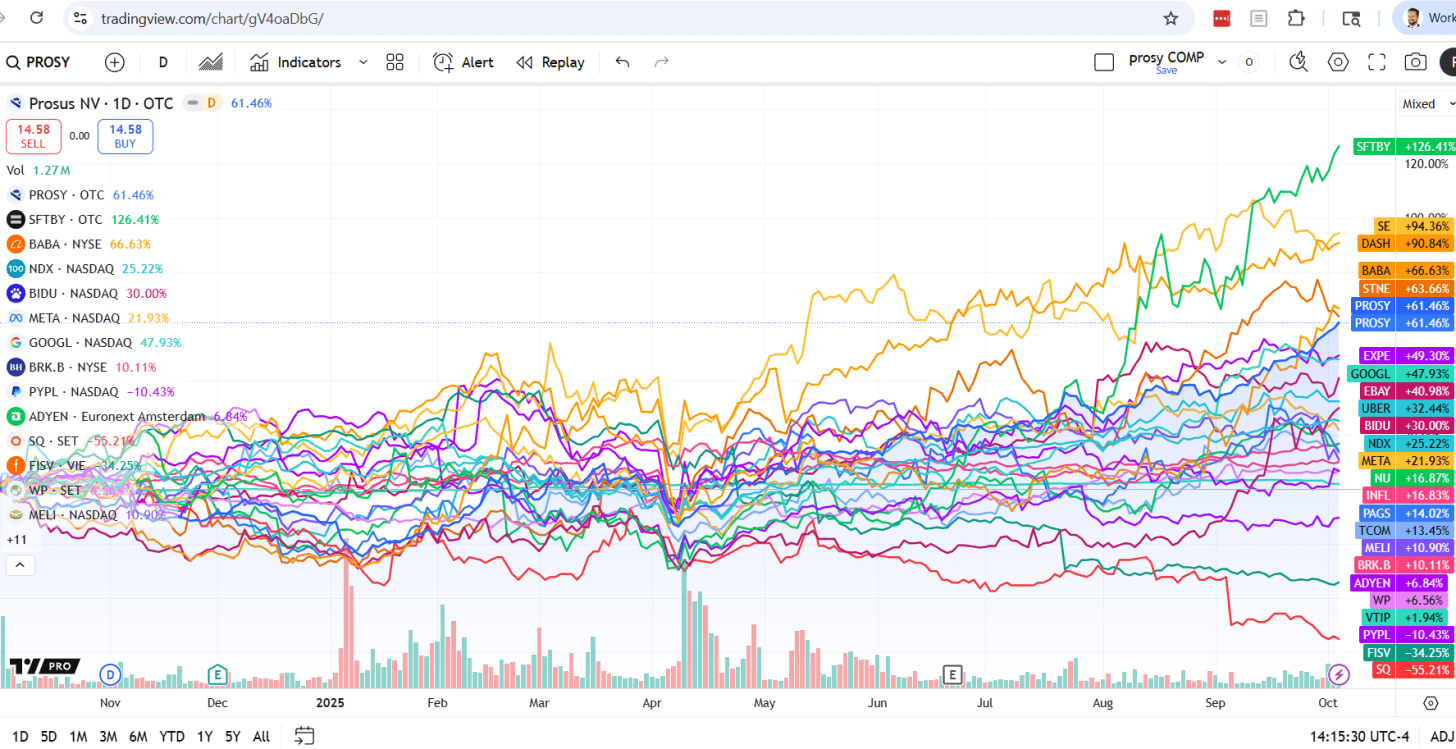
Prosy has many competitors given the breadth of its holdings, and over the last year, its returns are in the top six.
Across these verticals, Prosus contends with leading U.S.-listed tech and consumer internet companies, each possessing strong brands, entrenched user bases, and robust capital resources.
Here’s a comparison of some of the competitors on a few other metrics, along with my Adaptive Trader score for each.
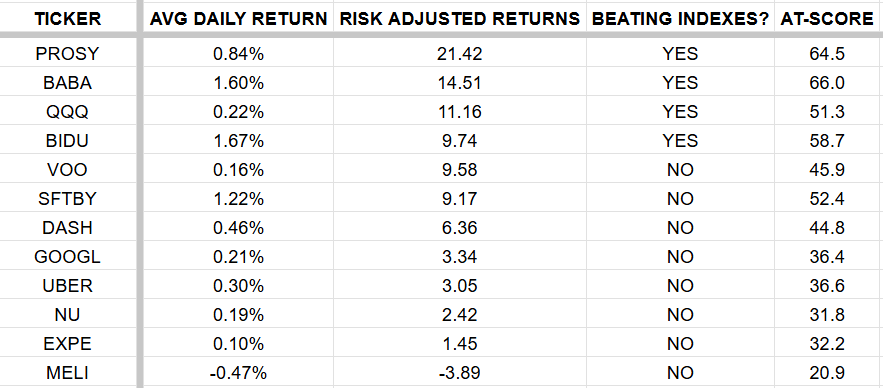
Over the last 21 market days, roughly one calendar month.
Share
What Trends Is Prosus Capitalizing On?
Online food delivery: Major stakes in iFood and Swiggy give Prosus a leading role as the global food delivery market heads toward a multi-hundred billion dollar opportunity.
Digital payments: Growth in emerging-market fintech and underbanked populations drive PayU’s expansion.
E-commerce and classifieds: Prosus’s international classifieds platforms, especially in emerging markets, benefit from accelerating online commerce penetration.
How Stable Is This Momentum?
Prosus’s strengths are significant portfolio diversification, improving underlying profitability, and growing cash flows. However, the company’s value is still largely tied to its stake in Tencent, exposing investors to Chinese regulatory and geopolitical risk.
Success depends on continuing operational progress and orderly portfolio rotation—any reversal could drive volatility.
The Bottom Line
Prosus’s dramatic turnaround into profitability, momentum from AI and tech adoption in emerging markets, and aggressive buybacks have attracted momentum traders seeking exposure to international tech growth stories.
Risks remain, but technical breakouts and sector leadership make Prosus a compelling watch for aggressive traders in 2025.
Subscribe now
Share
References
Finance Yahoo – Prosus profile and momentum gains, 2025
Reuters – Prosus business areas and global reach
Wikipedia – Prosus history, portfolio, and market role
Roic AI – Revenue, profit, and buyback data
Seeking Alpha – Breakdown of core tech investment strategy
CNBC – Prosus investment focus in food delivery and fintech
Emergen Research – Food delivery global market growth
Klover.ai – AI-first portfolio transformation