The Portfolio That Reveals How Smart Money Really Thinks
Not perfect. Not normal. Just something real — and really good.
Call me a nerd. I like to think up investment portfolios.
Tonight I was thinking about:
Long-term bets that align with enduring and unavoidable macroeconomic trends
ETFs on those themes that are more stable than companies
Being picky about based on consistently positive returns and risk-adjusted returns
Diversifying as much as possible without diluting its directional bet
BY GEORGE, I DISCLAIM: This content is for informational and educational purposes only and does not constitute financial, investment, or trading advice. I’m not a financial advisor, and nothing here should be interpreted as a recommendation to buy, sell, or hold any security. Do your own research. Talk to people you trust. And make decisions based on your own goals and risk tolerance.
Most investment advice falls into two camps: “buy and hold forever” or “trade the momentum.” But what if the smartest approach does both simultaneously?
After diving deep into eleven ETFs that capture the biggest macroeconomic trends of our time, I’ve discovered something counterintuitive about long-term investing. The best long-range bets aren’t just about picking the right themes—they’re about finding positions that work across multiple timeframes, from one month to five years.
Let me show you what the data reveals.
🧠 Head Check: When Multiple Timeframes Tell the Same Story
Here’s what most people miss about successful investing: the best opportunities aren’t just good long-term—they show momentum across multiple time horizons. Academic research shows that strategies combining momentum and mean reversion typically yield excess returns of around 1.1–1.7% per month and generally outperform pure momentum and pure mean reversion strategies. Is There Evidence for Momentum and Mean Reversion in Asset Class Returns? by Grant Holtes :: SSRN
This isn’t theoretical. It’s exactly what we see when we analyze eleven ETFs positioned around the biggest macroeconomic trends reshaping our world:
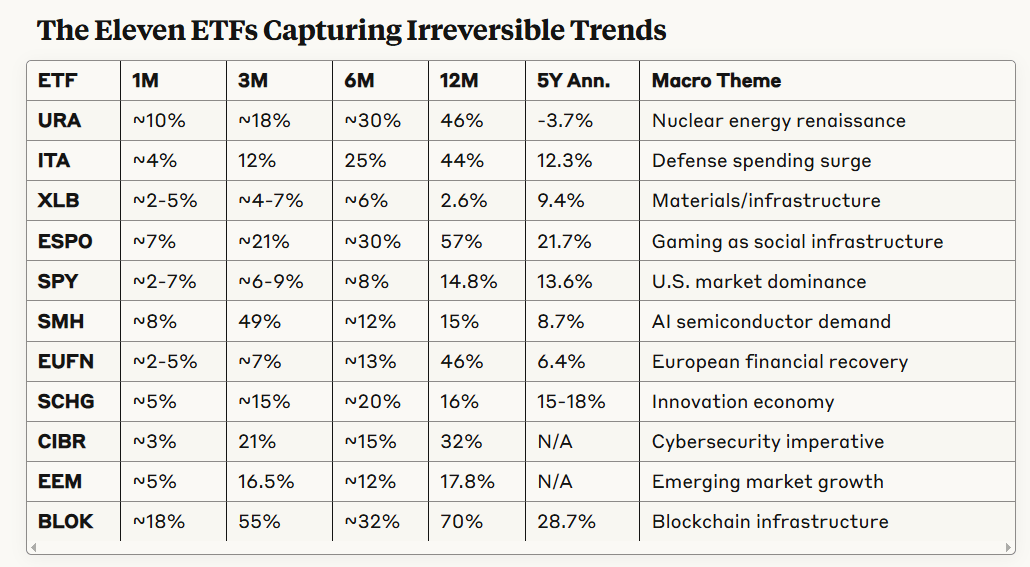
This isn’t just a portfolio. It’s a mirror of how smart money sees the world evolving.
The pattern is striking: the strongest performers across 12 months also showed consistent momentum across shorter timeframes. This isn’t coincidence—it’s how durable trends manifest in markets.
Crazy Good: Thinking better. Feeling deeper. Living smarter. is a reader-supported publication. To receive new posts and support my work, consider becoming a free or paid subscriber.
❤️ Heart Check: What the Numbers Actually Reveal
Look at BLOK (blockchain) with its 70% annual return. This wasn’t a meme stock pump. The rise of hyperscalers like Amazon and Google developing their own AI solutions marks a shift in the competitive landscape, while diversification highlights a growing ecosystem of players vying for market share SMH stock price prediction 2025: What is the future of SMH stock? | Markets.com. Blockchain infrastructure is becoming the rails for this new digital economy.
Or consider URA (uranium) with its 46% gain. URA delivered a remarkable 21% return in June 2025 alone, earning an A grade versus the 6.4% Natural Resources category average Global X Uranium ETF (URA) Performance History - Yahoo Finance. But this isn’t speculation—it’s physics. Small Modular Reactors (SMRs) address energy needs for AI-driven industries, offering sustainable solutions to power-intensive technologies SMH ETF: A Good Mix Of Semis To Benefit From AI Demand (NASDAQ:SMH) | Seeking Alpha.
The semiconductor story through SMH is equally compelling. SMH entered this week with year-to-date gains of more than 51% while hovering around 52-week highs Best Semiconductor ETFs to Watch in 2025. Yet 2025 brings potential for recovery as automotive chips are poised to gain traction as the electric vehicle market grows and demand for advanced driver-assistance systems accelerates 7 Best Semiconductor ETFs to Buy in 2025 | Investing | U.S. News.
These aren’t lucky picks. They’re positions aligned with irreversible technological and geopolitical shifts.
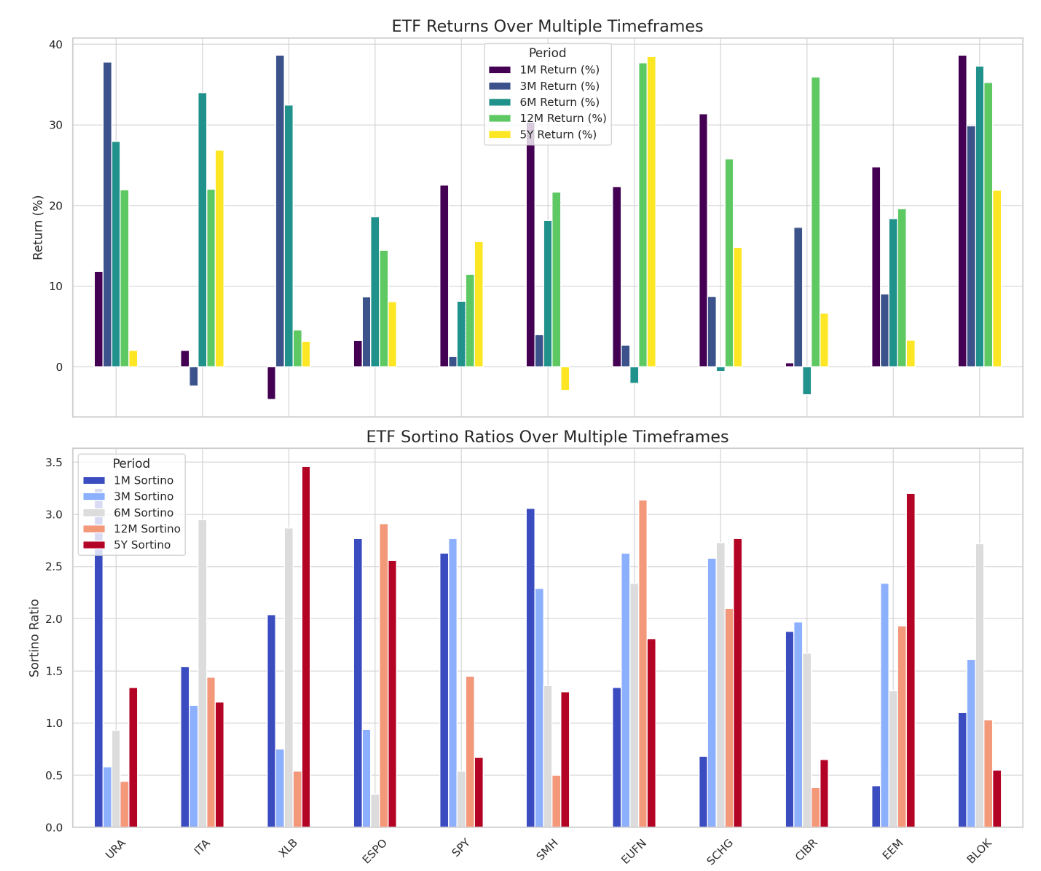
Sortino ratios, which calculates risk adjusted return, kinda like a Sharpe ratio, but more focused only on the volatility that causes losses, not gains. And BTW for a number of reasons, I decided I wasn’t as enamored by XLB as I was the others.
🧭 Gut Check: The Macroeconomic Framework That Drives Everything
The real insight comes from understanding the macroeconomic backdrop supporting these themes. The Fed’s rate-cutting cycle is expected to stall at 3.0–3.75% in the second half of 2025, 75 bps higher than pre-election expectations 10 Macro Themes for 2025 | Guggenheim Investments. This “higher-for-longer” environment creates specific winners:
Quality growth companies with pricing power (semiconductors, cybersecurity) Resource plays benefiting from supply constraints (uranium, materials)Defense/infrastructure with government backing (aerospace, European financials)
Meanwhile, 2025 will see greater differentiation between countries, with less correlation between markets and greater policy divergence as globalization takes a different, more reduced form Outlooks: Market and Economic Forecasts | Morgan Stanley. This supports domestic manufacturing themes and resource security plays.
The cybersecurity angle is particularly compelling. CIBR has $4.4 billion in assets with strong fund flows: $1.26B net inflows over one year and $892.86M over three months First Trust NASDAQ Cybersecurity ETF (CIBR) Latest Prices, Charts & News | Nasdaq. CIBR has outperformed other cybersecurity ETFs on both a general and risk-adjusted basis Cyber Security ETF | CYBR ETF | Evolve ETFs | Canada, reflecting institutional recognition of this necessity.
The Academic Foundation for Multi-Timeframe Thinking
This approach isn’t just intuitive—it’s academically validated. Financial modeling has long sought to develop frameworks that accurately capture the complex dynamics of asset prices, with traditional models often focusing on either momentum or mean reversion effects, struggling to incorporate both simultaneously Full article: Mean reversion in international markets: evidence from G.A.R.C.H. and half-life volatility models.
But recent research shows the power of integration. Studies that separately identified mean reversion and momentum find that combination momentum-contrarian strategies outperform both pure momentum and pure contrarian strategies Combining mean reversion and momentum trading strategies in foreign exchange markets | Request PDF.
Data by Morningstar shows the total amount invested in thematic funds grew to $718bn in Q4 2021, from $251bn two years earlier, with more than two-thirds of thematic funds globally surviving and outperforming global equity markets iShares MSCI Emerging Markets ETF (EEM) Stock Price, News, Quote & History - Yahoo Finance. The key is selectivity and academic rigor.
🔄 Life Change: The Framework for Positioning vs. Betting
Here’s what separates positioning from gambling: alignment with irreversible trends across multiple evidence sources.
Take the semiconductor thesis through SMH. The evidence spans:
Technical: MACD turned positive on January 16, 2025, with a 58% historical chance of gains in the next month 2 Technology ETFs to Invest $500 in Right Now @themotleyfool #stocks $AIQ $SMH
Fundamental: Memory market stabilization and stronger customer relationships driving a shift toward contract-based demand AI-Driven Semiconductor Growth | ETF Trends
Structural: AI infrastructure is being unbundled, with hyperscalers ramping up custom silicon efforts, creating opportunities across different chip architectures 5 Best Cybersecurity ETFs for 2025 | Investing | U.S. News
Or the nuclear energy case through URA:
Policy: Global governments recognizing nuclear as essential for carbon goals
Supply: URA trading near 52-week high of $41.60, up from low of $19.50 2025 Semiconductor Outlook: Investor Roadmap | ETF Trends
Demand: SMRs addressing energy needs for AI-driven industries SMH ETF: A Good Mix Of Semis To Benefit From AI Demand (NASDAQ:SMH) | Seeking Alpha
The pattern holds across cybersecurity (CIBR), emerging markets (EEM), and European financials (EUFN). Multiple timeframes, multiple evidence sources, all pointing in the same direction.
The Practical Investment Framework
Based on this analysis, here’s how to think about long-range positioning:
1. Identify Irreversible Macro Trends
Energy transition (nuclear, not just renewables)
Digitization security (cybersecurity as infrastructure)
Geopolitical shifts (defense, resource security)
Technological adoption (AI, blockchain, gaming)
2. Verify Multi-Timeframe Momentum
Look for assets showing momentum across 1-month, 3-month, 6-month, and 12-month periods Is There Evidence for Momentum and Mean Reversion in Asset Class Returns? by Grant Holtes :: SSRN. Pure short-term momentum fades; durable trends compound.
3. Check Academic and Institutional Validation
Research indicates that inclusion of ESG aspects in portfolio optimization may be beneficial for out-of-sample return and Sharpe ratio Optimal asset allocation strategies for international equity portfolios: A comparison of country versus industry optimization - ScienceDirect. Look for themes supported by peer-reviewed research and institutional capital flows.
4. Balance Core and Satellite Exposure
Use SPY or SCHG as your foundation—they’ve delivered consistent 13-16% annual returns with strong risk-adjusted profiles. Layer thematic exposure (SMH, URA, CIBR) as satellites.
5. Monitor Fundamentals, Not Noise
Mega forces are durable return drivers, but they don’t map into broad return drivers, requiring granular tracking of their evolution across and within asset classes World Economic Outlook - All Issues.
What This Means Right Now
The current moment offers unusual clarity. Global GDP is anticipated to rise 2.5% and core CPI inflation could remain sticky, remaining close to its current 3%, while divergence among central banks is a key outlook theme 2025 Midyear Investment Outlook | BII.
This environment favors exactly the themes showing up in our ETF analysis:
Quality growth over speculation
Resource security over efficiency
Technological infrastructure over consumer discretionary
Diversification beyond U.S. markets
🧠 Head Check: Are you positioned around irreversible trends or reacting to daily market noise?
❤️ Heart Check: Do your investments align with how the world is actually changing, not how you wish it would?
🧭 Gut Check: Are you diversified across themes that work in multiple scenarios?
The Meta-Insight That Changes Everything
Here’s what this analysis reveals about successful long-term investing: the best opportunities show momentum across multiple timeframes because they’re aligned with fundamental shifts in how the world works.
URA’s 46% gain isn’t about uranium speculation—it’s about energy physics and geopolitical reality.
SMH’s semiconductor rally isn’t about AI hype—it’s about the infrastructure requirements of digitization.
CIBR’s cybersecurity surge isn’t about fear-mongering—it’s about the vulnerability cost of connectivity.
Academic research over 30 years shows that thematic investing works when chosen with strong supporting evidence and proper diversification iShares MSCI Emerging Markets ETF (EEM) Stock Price, News, Quote & History - Yahoo Finance.
The framework scales beyond investing. The same principles that identify durable investment themes help identify career moves, skill development priorities, and life positioning strategies.
Great portfolios and great lives are built the same way:
By aligning with what’s real, not what’s trendy — and by staying in motion as the world shifts.
The research cited in this analysis draws from academic papers, institutional reports, and real-time market data. For the complete bibliography and deeper analysis of each theme, subscribe to the monthly deep-dive series.
Remember: not perfect, not normal, just something real—and really good. That applies to both portfolio construction and life decisions.
Share
Crazy Good: Thinking better. Feeling deeper. Living smarter. is a reader-supported publication. To receive new posts and support my work, consider becoming a free or paid subscriber.