What a Livestock Publication Taught Me About Competitive Advantage
I recently facilitated a workshop for Tri-State Livestock News, a multi-state agricultural publication preparing for their “Super Bowl season”—the November through April period when cattle sales peak and ad revenue surges.
What I learned from spending time with farmers, ranchers, field reps, and editors wasn’t just about agriculture. It was about something every business struggles with: how do you turn challenges into competitive advantages when your industry is being disrupted?
Subscribe now
Print media is supposedly dying. Younger generations don’t read newspapers. Digital competitors can undercut on price. AI can generate content faster and cheaper.
Yet here’s a team that’s not just surviving—they’re positioned to dominate their market.
Here’s what they know that most businesses miss.
The Geography Advantage Nobody Talks About
When I asked the team to identify their unique competitive advantages, something unexpected emerged: they all live in their territories.
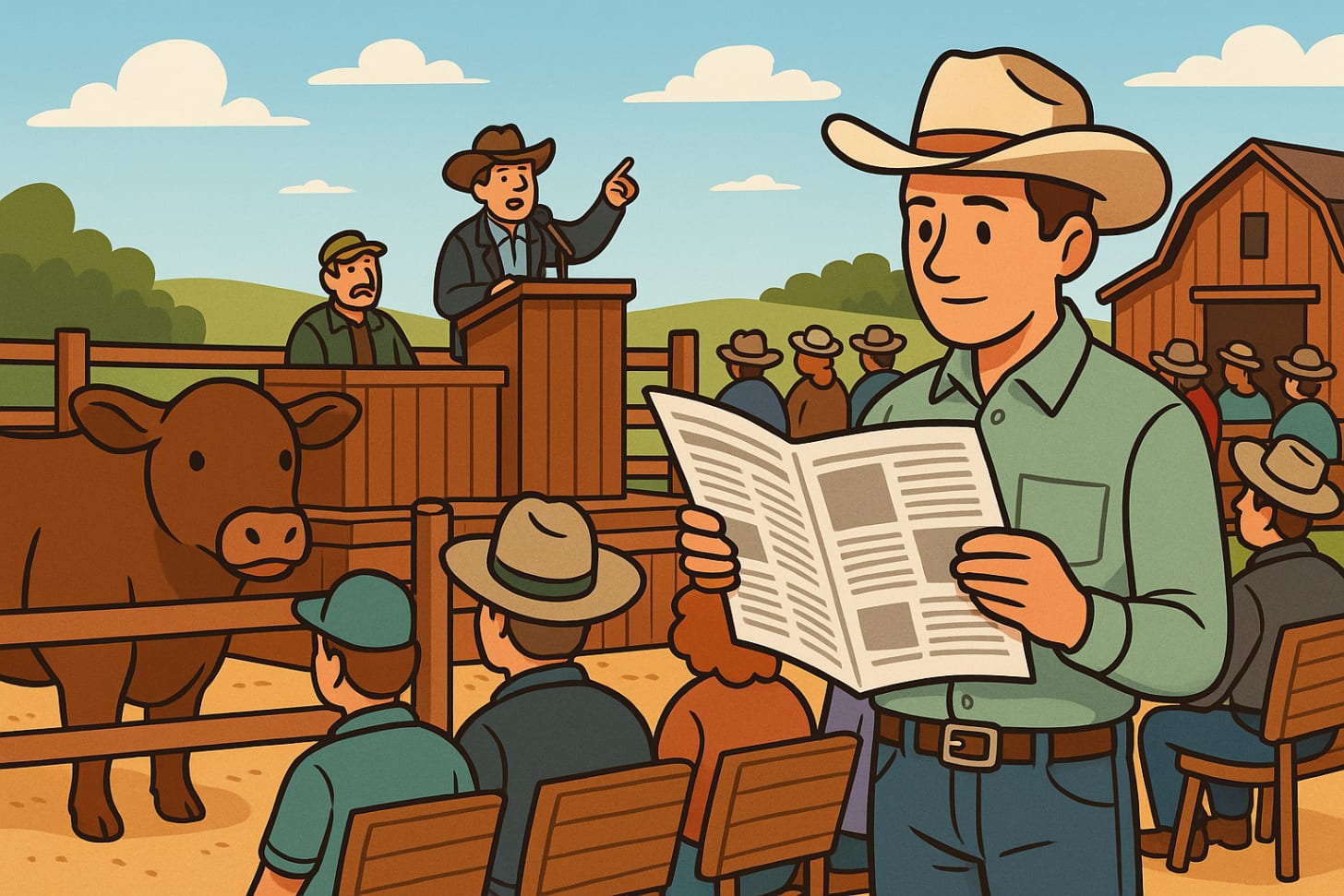
Their livestock field reps aren’t commuting from corporate headquarters. One covers South Dakota from the middle of South Dakota. Another lives in his Montana territory. They can cover for each other across state lines when needed, but they’re embedded in the communities they serve.
As one field rep explained: “We’re scattered through our territory. Everybody lives in their territory and fairly central to their territory. But we can also help each other out big time—me covering a sale for Cody or Cody coming up to South Dakota and covering something for me.”
This creates an advantage most companies don’t even think about: they have an expense account to visit customers, while commission-only competitors have to pay for their own gas and hotels to make ranch visits.
The editorial team echoed this: “We are very geographically spread out, and we have an advantage of being very familiar with our region’s industries. We’re very familiar across the board, very well balanced. Just being present—they see us where they expect to see us. They see us at the sale barn, and they see us at the bull sale. They see us at the farm show.”
When was the last time you thought about physical presence as a competitive advantage in a digital world?
Share
The “We’re Not Fake News” Moat
In an era where media credibility is at historic lows, one competitive advantage rose to the top repeatedly during our exercises: credibility.
Multiple departments independently identified it. The sales team talked about how being present in their territory builds trust. The editorial team discussed being “very familiar with our region’s industries” and showing up where subscribers expect to see them. The production team mentioned how industry knowledge prevents “simple mistakes” that erode credibility.
One person summarized it perfectly: “We’re not fake news—we’re there.”
Think about that for a moment. In most industries, “we’re not frauds” isn’t a competitive advantage—it’s table stakes. But when trust has eroded industry-wide, authenticity becomes a moat.
This isn’t just about media. If you’re in any industry facing a trust crisis—financial services, healthcare, real estate, politics—your competitors’ reputation problems become your opportunity. But only if you can prove you’re different.
How to Market Being the Biggest Without Sounding Like You’re Bragging
During the workshop, the editorial team had an insight that most businesses struggle with:
“I think we need to take better advantage of connecting the publications to show how big we actually are. We need to do a better job of advertising that we’re the biggest. Nobody can compete with our footprint. We’ve been around a long time. We’re durable, we’re credible. We’re not going anywhere. I don’t think we are.”
This tension is real: How do you communicate dominance without seeming arrogant? How do you leverage scale without losing the personal touch that made you successful?
Their answer: lean into alignment between their size and their audience’s values.
“If we weren’t traditional, we wouldn’t have any credibility with our people. They don’t really want [digital-first approaches].”
Agriculture values tradition, durability, and proven methods. A publication that’s been around for decades isn’t outdated—it’s trustworthy. Print isn’t dying—it’s authentic. Being the biggest isn’t corporate bloat—it’s reach and reliability.
The lesson: Your competitive advantage isn’t just what you do—it’s how well it aligns with what your customers value.
The Compliment Exercise That Reveals Team Health
Midway through the workshop, I asked participants to turn to someone next to them and exchange genuine compliments. Not “nice shirt” surface-level stuff, but real recognition.
Here’s what emerged:
“Dusty is the best person ever. He’s always there for us. He has saved my life more than once.”
“I said Christine was really good at her job and she’s saved my butt a lot trying to learn everything.”
What struck me wasn’t just the warmth—it was the specificity. People weren’t complimenting abstract qualities. They were recognizing concrete ways colleagues had helped them.
This reveals something crucial about organizational health: Do people know specifically how their colleagues make their work possible?
If your team can’t immediately articulate how coworkers add value, you either have a recognition problem or a collaboration problem. Both are fixable, but you need to know which one you’re solving.
What Veterans Learn From Newcomers (And Vice Versa)
I paired veterans with newer team members and asked them to exchange lessons. The veteran shared a survival lesson; the newcomer offered a fresh perspective.
One veteran shared: “Adapting to change and always being open-minded to the younger generation with younger ideas. When I started in this industry, I didn’t even have a computer. I had to learn all of those steps. If I hadn’t learned from the younger crowd, I never would have gotten there.”
A newer employee offered: “I’ve learned that mistakes don’t define you. In the newspaper business, mistakes are hard to face because everybody sees them. Having a great, supportive boss helps with dealing with that.”
Another insight from a newcomer: “If you have to be nimble and veer from your original plan, it’s not a sign of weakness. Being able to be nimble is a positive.”
Notice the pattern? Veterans talked about technological adaptation and staying open. Newcomers talked about psychological safety and strategic flexibility.
Veterans had to learn technical skills they never imagined needing. Newcomers have to learn that public failure is survivable.
Both lessons are crucial. Most companies only teach one direction.
The Production Department Nobody Appreciates
Production departments are easy to overlook. They don’t bring in revenue. They’re not customer-facing. They do “back-office” work.
But when I asked the production team about their competitive advantage, something interesting emerged: “Creative staff. Our weekly publications are exceptional—they’re award-winning. Our magazines are exceptional.”
The circulation and advertising manager added: “We all have the knowledge of being around agriculture long-term. Some of us are farmers. We also carry a good background of previous experiences. When something goes wrong in our production area, some of us know how to fix it. We know the difference between a sugar beet and a red beet, the different kinds of cows.”
Domain expertise in production creates quality that customers notice even if they can’t articulate why.
When someone who actually understands agriculture lays out a cattle sale ad, it looks different from when a generic designer does it. The fonts are appropriate. The terminology is correct. The emphasis is in the right places.
This compounds over time. Bad production creates friction every single issue. Great production removes friction and builds trust incrementally.
The November-to-April Super Bowl Strategy
As we closed the workshop, I asked each person to write down how they’d approach the upcoming peak season differently and commit to one thing for the team.
The patterns that emerged:
Sell early. Multiple people independently committed to getting ahead of deadlines instead of scrambling at the end. One person explained: “We went through our calendar yesterday. We know where everybody’s sale is. We know what they did last year. We just need to get to them early. The earlier we get to them, the easier it is at the end because we’re not forcing our deadlines.”
Be present in the moment. One sales team member said: “When you go visit a customer, be present. Don’t be thinking about all the things you need to do besides that. When you’re at an event surrounded by potential subscribers or customers, be present in the event.”
Look outside the box. Multiple people committed to finding new approaches—”new or different advertisements,” “new ways to share content with readers,” “different ways to get our content out there.”
Learn the depth. A newer employee committed to “learning more of the in-depth details of the paper now that I can slow down and see things for what they’re doing.”
These aren’t revolutionary strategies. They’re fundamentals executed well. But that’s the point: Most competitive advantages aren’t secret weapons—they’re basics done consistently while competitors get distracted.
What This Means for Your Business
You don’t need to be in agriculture or media to apply these lessons:
Map your geographic advantages. Where do you have presence that competitors don’t? How can you leverage that into trust and intelligence?
Audit your credibility gaps. In your industry, what erodes trust? How are you systematically building the opposite?
Find your size-value alignment. Are you big? Small? Somewhere in between? What does your customer segment actually value about company size?
Exchange generational wisdom formally. Don’t wait for organic knowledge transfer. Create structured opportunities for veterans and newcomers to teach each other.
Elevate your production quality through domain expertise. Hire people who actually understand your customers’ world, even in “back-office” roles.
Identify your Super Bowl season. When does your business peak? How do you prepare differently for it versus treating every month the same?
The team at Tri-State Livestock News isn’t thriving because they found a hack or exploited a loophole. They’re winning because they’ve identified genuine competitive advantages—credibility, geographic presence, generational depth, domain expertise—and they’re ruthlessly consistent about leveraging them.
That’s not sexy. But it works.
And in a world obsessed with shortcuts and growth hacks, maybe “boring but effective” is the ultimate competitive advantage.
What advantages does your company have that you’re not fully leveraging? What would change if you stopped chasing “innovative” strategies and instead doubled down on the fundamentals your competitors are too distracted to execute well?
Subscribe now
Share