Your Brain is Sabotaging Your Future (And Mine Too)
I know that checking my Robinhood account daily destroys returns.
I’ve read the studies. I’ve written about behavioral finance.
And yet my boring Vanguard account consistently crushes my “optimized” Robinhood one because I can’t stop myself from reacting to every market twitch.
[Here’s a clue: don’t trade spontaneously on your phone. Make sure you have all your research, analysis, charts, etc. in front of you at a desk. There are a few times when the phone approach is needed, but don’t make it a habit.]
If someone who studies cognitive bias still falls for this, what chance do the rest of us have?
The Brutal Reality: We Don’t Just Make Mistakes—We Make the Same Mistakes, Predictably
🧠 Fast vs. Slow Thinking (System 1 vs. System 2)
Daniel Kahneman taught us that most of our decisions come from System 1—fast, emotional, automatic thinking.
Our rational brain (System 2) usually just rubber-stamps what System 1 already decided.
Market version: You think you’re diversifying, but you’re just buying five flavors of tech. They all crash together.
Life version: You “decide” your vacation will be relaxing—then let System 1 pack every day with tours and stress.
“Crazy Good: Think better. Feel deeper. Live smarter” is a reader-supported publication. To receive new posts and support my work, consider becoming a free or paid subscriber.
Why We’re Wired for “Stupid” Decisions
Survival First, Accuracy Second Our brains evolved when being wrong about a lion in the bushes meant death, but being wrong about whether those berries were perfectly ripe just meant mild disappointment.
As Kahneman himself explained: “for an organism operating close to the edge of survival, the loss of a day’s food could cause death, whereas the gain of an extra day’s food would not cause an extra day of life.”
Loss aversion isn’t broken - it kept our ancestors alive. Better to obsess over potential losses than miss real threats.
Speed Over Precision System 1 thinking “allows us to make quick decisions and judgments based on patterns and experiences.”
When you needed to instantly recognize “predator” vs “prey” vs “mate,” fast pattern matching was literally life or death. Taking time to carefully analyze whether that rustling bush contained a tiger would get you eaten.
The availability heuristic makes perfect sense in a small tribe - if you personally saw three people die from eating red berries, red berries probably ARE dangerous in your environment.
Your brain didn’t evolve for a world where you see 10,000 scary news stories about statistically irrelevant risks.
Energy Conservation As research shows, “System 2 is a lazy controller and doesn’t like to expend much effort” and for good reason. Thinking burns massive calories (your brain is 2% of your body weight but uses 20% of your energy). In a world of food scarcity, being mentally lazy most of the time was adaptive.
What These “Bugs” Are Actually Good For
Pattern Recognition Mastery Your ability to instantly recognize faces, navigate familiar routes, or feel that something is “off” in a social situation - that’s System 1 being brilliant. Professional musicians, athletes, and chess masters rely heavily on these instant pattern-matching abilities.
Social Cohesion Many biases help groups stick together. Loss aversion makes you loyal to your “tribe” (family, company, country). Availability bias means shared dramatic experiences bond groups strongly.
Efficient Satisficing Most decisions don’t need to be perfect - they need to be “good enough, fast enough.” What restaurant to pick, which route to take, whether to trust someone - System 1’s quick approximations work fine 95% of the time.
The Modern Problem: We’re running ancient software on modern hardware. Our brains are optimized for immediate physical threats, small groups, and simple cause-and-effect relationships. But now we need to make decisions about:
Complex financial instruments that won’t pay off for decades
Global supply chains and statistical risks
Information from millions of sources we’ll never meet
Your brain isn’t broken - it’s just a Paleolithic mind trying to navigate a digital world. The “bugs” were features when tigers were chasing you. Now they make you panic-sell during market dips and stay in toxic jobs.
⚡ Loss Aversion: The Pain of Letting Go
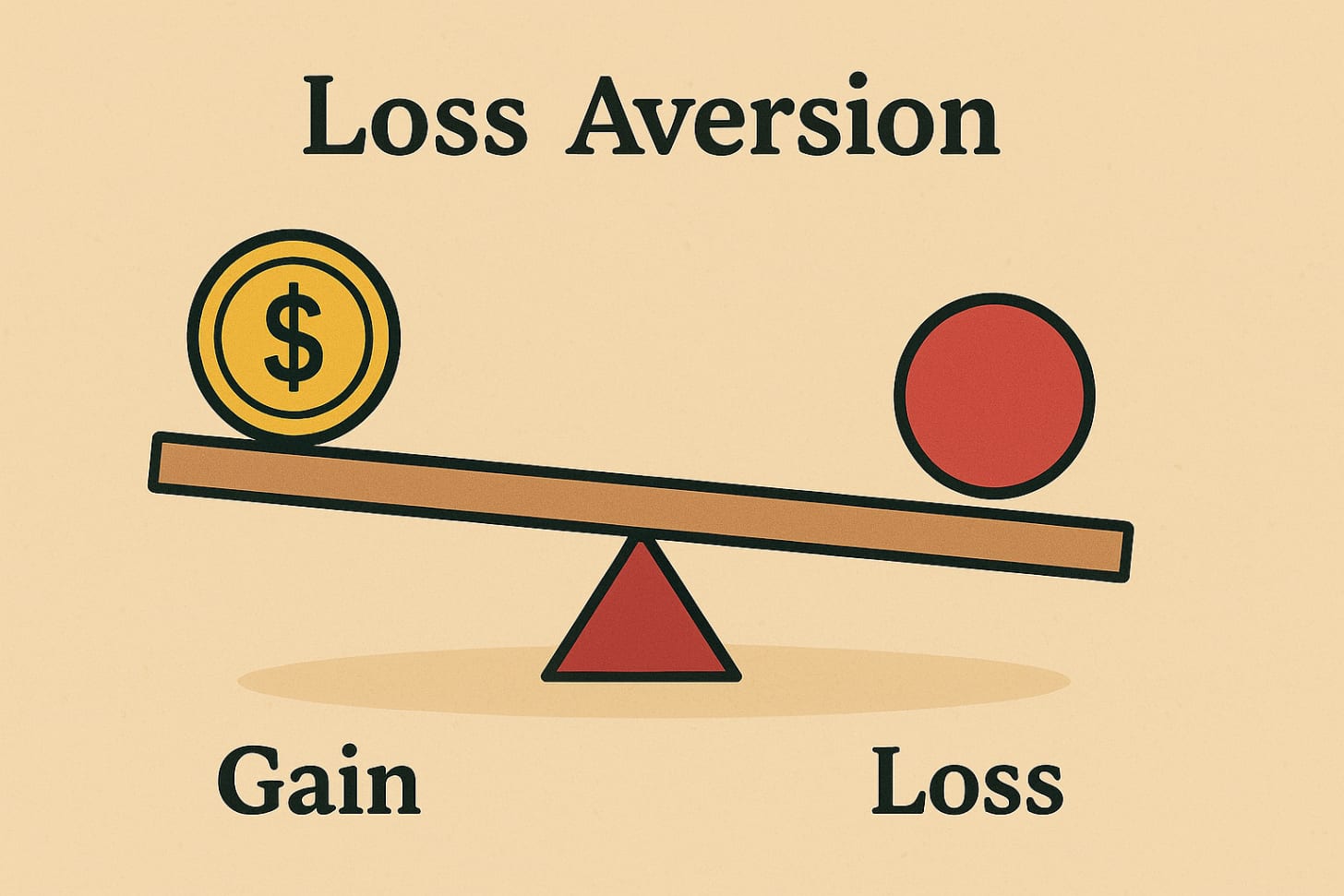
We feel losses twice as strongly as equivalent gains (Prospect Theory).
You cling to losing stocks.
You stayed in that job or relationship two years too long.
You pack vacations with activities because of FOMO.
Loss aversion isn’t about bad judgment—it’s about how your nervous system is wired.
📺 The Availability Heuristic: Scary Headlines Beat Boring Data
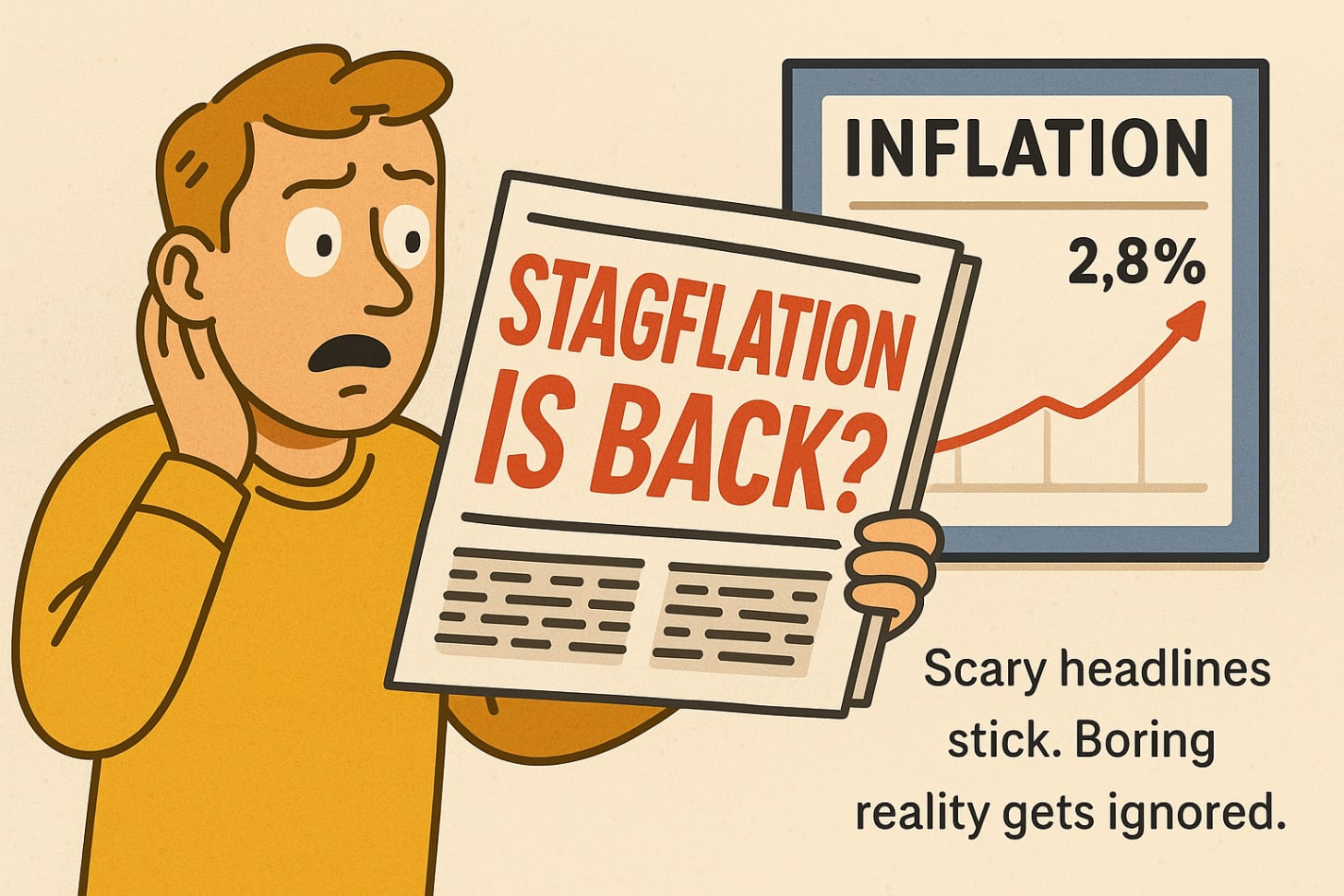
If something is vivid or recent, we think it’s more likely.
Calling 2.8% inflation “stagflation” because the 1970s were scary. It was more like 9-10% back then.
Avoiding markets after one crash headline, ignoring decades of gains. This happened to me! I resented the S&P500 for dipping in April 2025, and my lack of experience kept me from getting back in fast enough. Won’t do that again!
Your brain catastrophizes because fear sells better than reality.
Thanks for reading “Crazy Good: Think better. Feel deeper. Live smarter”! This post is public so feel free to share it.
Share
🔮 Representativeness Bias: Seeing Patterns That Aren’t There
We decide based on resemblance, not probability.
H-T-H-T looks more “random” than H-H-H-T-T-T, even though both are equally likely.
Hot stocks “look” like winners, so you chase them, ignoring fundamentals.
The brain’s pattern-seeking module is overclocked—and expensive.
How These Biases Show Up Everywhere
Investing: Overtrading, bad diversification, buying stories not numbers.
Work: Staying in the wrong career out of loss aversion.
Life: Vacations that need another vacation.
Relationships: Holding onto toxic situations because the familiar feels safer than change.
Different domains. Same broken wetware.
Building Anti-Fragile Systems
You can’t outsmart your brain. You can only design guardrails.
Automate the rational → pre-commit to investing, rebalancing, and saving.
Pre-decide under pressure → “If SPY drops 5%, then I rebalance, not panic-sell.”
Diversify beyond comfort → include assets that feel weird (gold, inflation hedges, energy) so your portfolio survives.
Engineer real rest → plan vacations with actual downtime, not just busyness.
Audit assumptions → write down why you’re holding each stock, habit, or relationship, and review quarterly.
Crazy Good Life Checklist
🔍 Question assumptions regularly.
🛠 Build systems that keep working when you don’t.
⏸ Distinguish signal from noise—daily twitch vs. multi-month trend.
🌱 Choose what compounds—whether in markets, relationships, or health.
The Takeaway
Your brain is wired to sabotage you. Mine too.
The goal isn’t to “be smarter.” It’s to build systems that keep working even when we’re predictably stupid.
Because the mistakes are coming—repeatedly, systematically, and probably right now.
Stop it!!!! 🤣
Subscribe now
Share
Leave a comment